
I opened an email the other day because the subject line promised to explain why some books are impossible to put down. I wanted to know.
Seriously. I’ve been writing fiction professionally for decades, and I’ve published more than 200 books. Readers have told me many times that they couldn’t put one of my books down, stayed up far too late reading it, or read the whole thing in a sitting.
And I still don’t know exactly how you make that happen.
So when someone promises an answer, I’m interested.
The email turned out to be about story structure.
Story structure?
Yes, structure matters. So do pacing, character, concept, emotional stakes, narrative voice, dialogue, tension, secondary characters, setting, unanswered questions, anticipation, conflict, prose, and probably fifty other things I haven’t thought of yet.
But none of them, individually, explains why some books grab hold of a reader and simply will not let go. And I don’t think anyone can teach you how to write one that will.
The Book I Couldn’t Put Down
I’m going to admit something embarrassing. The last books I can remember being genuinely unable to put down were the Twilight books. There. I said it.
I watched the first movie with my daughter, who uttered the fatal words: “Of course, there’s a lot more to the story in the book.” I started the first book the next day.
I finished the entire series in four days.
I had a day job at the time. Those are enormous books. I have no idea when I slept. I’ve wondered many times since what those books did to me.
Was it the basic premise? Vampires certainly weren’t new. Was it waiting for Bella and Edward to get together? That explains some of it, except I kept reading compulsively after they did.
Was it Stephenie Meyer’s narrative voice? The emotional intensity? The constant wanting? The complications? The characters? The questions that kept replacing other questions as they were answered?
Probably. Probably all of the above. And something else. And perhaps three other somethings.
That’s the problem.
Fiction Has a Very Large Control Panel
Think about the control panel in a professional recording studio. There are sliders and knobs and switches everywhere. Each one has a whole spectrum of possible settings.
Fiction is like that. Concept isn’t simply present or absent. Neither is tension. Or emotional intensity. Or character likability. Or novelty. Or pacing. Or humour. Or narrative distance. Every one of them has a long spectrum of possible intensities or variations, and you can choose anywhere along that spectrum for your novel.
Then the settings all interact with each other. Change one setting and suddenly another one that was perfect before is too high or too low.
The number of possible settings per element are many. Combine them with all the possible settings for all the other elements in a novel, and the number of variations of possible settings is astronomical.
An irresistible book may have hit an extraordinary combination of settings. We can study that book afterwards and identify many of them. But what if there are 150 controls and we’ve successfully identified 120?
We reproduce those 120 settings perfectly. Then we guess at the other thirty. And the new book falls flat.
It contains everything we thought made the first book compulsive. Except it isn’t.
Then the Reader Walks Into the Studio
Unfortunately, the book’s control panel is only the first.
The reader brings another one. Readers have their own tastes, experiences, expectations, moods and peculiarities.
Some readers won’t touch first-person narration. Others dislike third person. Some can’t stand present tense. Some won’t read romance. Or science fiction. Or vampires, sparkling or otherwise.
A character one reader would happily follow through seven books makes another reader want to throw Book One across the room.
Even timing matters at the individual level. The book that consumes you during one period of your life might leave you cold five years later.
So an “irresistible book” isn’t necessarily irresistible. It’s irresistible to someone.
And if enough someones have that reaction at approximately the same time, something interesting may begin to happen.
And Now We’re Not Even Talking About Craft Anymore
Suppose you somehow manage to get all the craft controls exactly right. You have written a book that a large number of readers would find compulsive.
Will it break out?
No one knows.
Truly. Not even New York publishers really know what makes a book a success while other, possibly better-crafted novels don’t do nearly as well.
And I’m afraid I’m going to repeat my favourite William Goldman quote about Hollywood, because it is so absolutely on the money, and applies equally as well to publishing:
Nobody knows anything…… Not one person in the entire motion picture field knows for a certainty what’s going to work. Every time out it’s a guess and, if you’re lucky, an educated one.
Now we add the cultural climate. The economy. Current reading fashions. What else has recently become popular. What readers are tired of. What they’re suddenly hungry for.
Then marketing enters the equation.
The cover. The title. The blurb. Pricing. Distribution. Advertising. Algorithms. Retailer visibility. Reviews. Influencers. Publicity. Word of mouth.
Timing.
Luck.
And all these variables interact with each other, too.
No one can control for all factors.
Goldman wasn’t saying nobody in Hollywood knew how to make movies. They knew and still know an extraordinary amount about making movies.
They just couldn’t reliably know which movie the audience would embrace.
Publishing has much the same problem. We know a tremendous amount about making books. We don’t know how to manufacture a phenomenon. If publishers did know, they would do it every Tuesday.
So Why Bother Learning the Controls?
Because writing an irresistible book isn’t actually the job. Writing good books is.
Learn how tension works. Learn pacing. Character. Dialogue. Story structure. Voice. Conflict. Emotional stakes. Description. Worldbuilding. Beginnings. Endings. All of it.
Learn as many controls as you possibly can, and get better and better at adjusting them. Because those skills can help you write books that are entertaining.
Readable.
Moving.
Funny.
Comforting.
Exciting.
Thought-provoking.
Inspiring.
Memorable.
Lovable.
A book doesn’t have to keep someone awake until three in the morning to matter to them. Some of my favourite books aren’t compulsive reads at all. I can put them down perfectly easily when life intervenes. But I still love them.
“Couldn’t put it down” is only one possible form of reader love.
Find the People Who Love What You Do
Which brings me, yet again, to Kevin Kelly’s idea of 1,000 True Fans. The more I think about sustainable indie publishing, the more roads seem to lead back there.
You don’t need to figure out how to make everyone want your book. You need to find the people who love the sorts of books you write.
If enough of those readers stick around, buy the next book, join your mailing list, recommend you to friends and keep coming back, they give you something extraordinarily valuable: Time and attempts.
You get to write another book. And another.
You get to experiment with the controls. Try different combinations. Improve your craft. Take chances. Occasionally get things wrong.
Every new book does not have to become a phenomenon in order to justify the existence of your writing career. Your readers are there because they like what you do.
And that gives you another throw.
Keep Throwing Spaghetti
There’s another version of Goldman’s observation that has become part of the general creative-industry vocabulary: nobody knows what will work, so we’re all throwing spaghetti at the wall to see what sticks.
That’s publishing.
But there’s a crucial difference between throwing spaghetti blindly and learning your craft. The better you understand those controls, the better the spaghetti gets.
Your stories become stronger. Your characters become richer. Your prose becomes cleaner. You become better at producing the emotional experiences you intended to produce.
And perhaps one day you write a book where every control happens to land at precisely the right setting. It reaches precisely the right readers. At precisely the right cultural moment. With precisely the right exposure.
And the spaghetti sticks to the ceiling.
And maybe it won’t. That’s okay. Because if you’ve found your tribe of readers who love your books, you can keep throwing spaghetti at the wall for many, many years. You don’t need a breakout to have a successful writing career.
Build a career that can survive indefinitely without one. Learn the controls. Write beautiful books. Find the people who love them. Keep writing more. And if lightning happens to strike one day?
Wonderful. Celebrate for a month, party like there’s no tomorrow and you’re 18 again, enjoy it.
But know that everything you did before the lightning strike wasn’t preparation for success. It was success.
Now Available.

The Anti-Ensh*ttification Field Manual for Indie Authors:
Because the platforms will decay…but your career doesn’t have to go down with them.
Now Available.
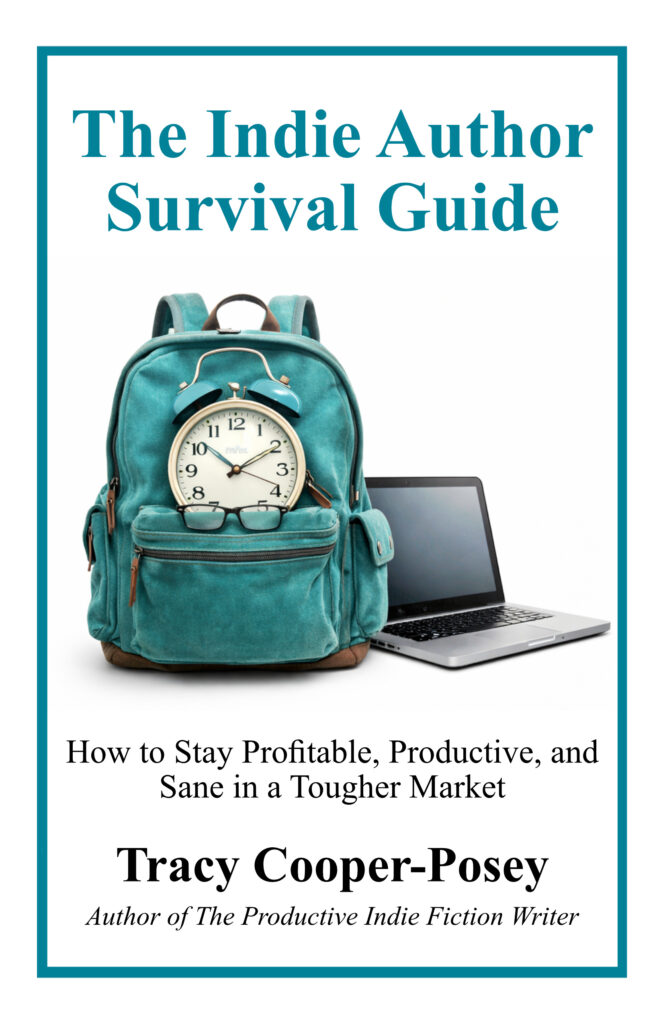
The Indie Author Survival Guide
How to Stay Profitable, Productive and Sane in a Tougher Market
Now Available.

The Productive Indie Fiction Writer: Strategies for Writing More, Earning More, and Living Well
Write More, Faster Than Ever Before | Are You Prolific?
Editing Your Next Novel? Mark Posey offers fast, writer-friendly edits with zero drama. Check out services »