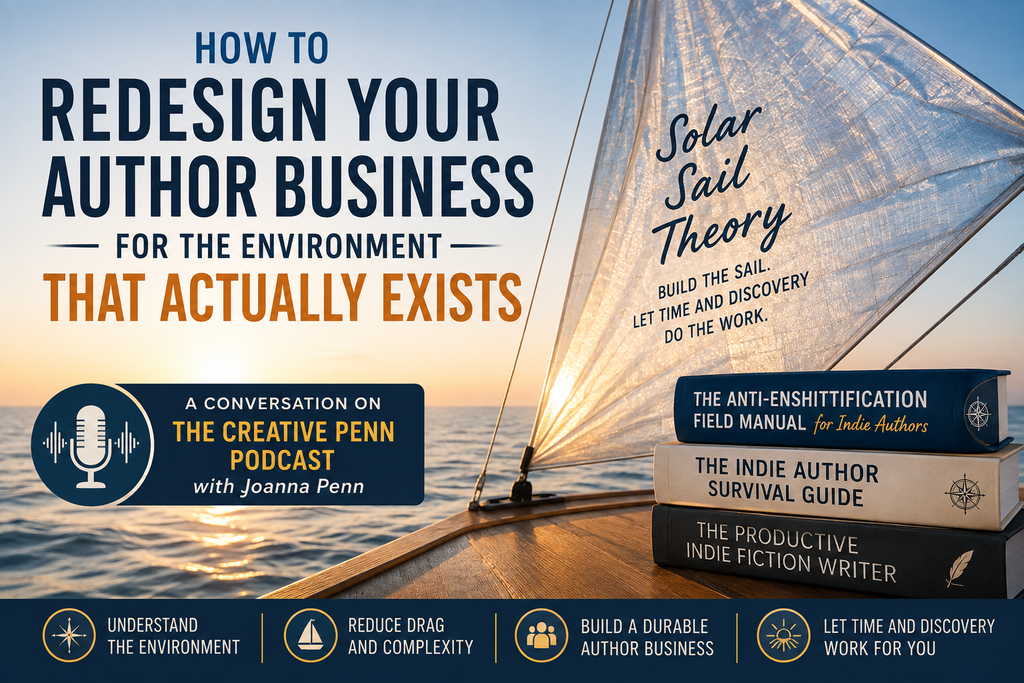
Today I had the pleasure of returning to Joanna Penn’s The Creative Penn Podcast, three years after my last appearance on the show.
That earlier conversation was largely about The Productive Indie Fiction Writer. This time, Joanna invited me back to talk about some of the ideas I’ve been exploring since then—particularly those in The Anti-Enshittification Field Manual for Indie Authors and The Indie Author Survival Guide.
The result is an hour-long conversation about the indie publishing environment we actually have now, rather than the one many of us learned to operate in ten or fifteen years ago.
You can listen to the full interview here.
And you can also read the full transcript and Joanna’s show notes at The Creative Penn:
The Environment Changed. That Doesn’t Mean You Failed.
One of the most important things we talked about was the realization that eventually led me to write The Anti-Enshittification Field Manual for Indie Authors.
For several years, I had the uncomfortable feeling that things simply weren’t working the way they used to.
Organic reach was disappearing. Advertising was becoming more expensive. Subscription costs were creeping upward. Platforms were changing their algorithms, terms, features and discoverability systems. Things that had once worked reliably for indie authors either stopped working or required considerably more effort and money to produce the same results.
And because each problem arrived separately, it was very easy to think: What am I doing wrong?
Understanding Cory Doctorow’s concept of enshittification, and applying that pattern to the platforms and services on which indie publishing has been built, changed my perspective completely.
It was actually an enormously positive realization. Because if the environment has changed, then the answer isn’t necessarily to work harder at strategies designed for the old environment. You can redesign your business for the environment that actually exists. That gives you agency again.
Building a Business That Can Keep Going
Joanna and I also talked about what a durable indie author business might look like now. There isn’t a fifteen-step formula anymore—if there ever was one.
Every author is working with a different collection of books, genres, skills, resources, health, time, ambitions and personal circumstances. What works brilliantly for one author may be completely inappropriate for another.
What matters more is developing the ability to recognize what is happening around you, experiment, adapt, and maintain enough independence that one platform change doesn’t have the power to wreck your entire business.
That might include diversified income, direct sales, a durable backlist, strong reader relationships and multiple routes to market. But the individual tactics matter less than the mindset behind them.
We Also Talked About Solar Sails
Joanna has been following my posts about Solar Sail Theory for some time, so we finally had the chance to talk about that at length. The idea is simple. A solar sail in space is pushed by photons. Each photon provides an almost unimaginably tiny amount of force, but give it a sufficiently large sail and enough time, and all those tiny pushes accumulate into substantial movement.
I use the same idea as a decision-making tool for author marketing. Whenever I’m considering a marketing activity, one of the questions I ask is: Does this extend my sail?
Does it leave something behind that can help readers discover me next month, next year, or ten years from now? A thirty-second radio advertisement disappears as soon as it airs. A social media post has a very short half-life. A podcast interview, however, may continue bringing readers to you years later.
So can a useful blog post. So can a library book, a guest interview, your own website, and every book in your back catalogue.
In fact, my previous appearance on The Creative Penn is still sending people to The Productive Indie Fiction Writer three years later. Which makes this particular podcast interview a rather satisfyingly recursive example of Solar Sail Theory in action.
And Then There’s Drag
Of course, there’s not much point building an enormous sail if your business is dragging a sea anchor behind it.
We also talked about operational drag: all the accumulated expenses, subscriptions, repetitive tasks, maintenance, advertising, obsolete processes and general business cruft that slow down a mature author business. Some of those things were once useful. Some are still useful.
Some are things we’ve been doing for so long that we’ve forgotten why we started doing them. Reducing that drag can sometimes improve an author business more effectively than adding yet another marketing strategy.
An Unexpected Detour: Learning to Write Again
We also ended up talking about something I hadn’t expected to discuss in detail. When Joanna and I last spoke in 2023, I had recently gone into remission from cancer. I’m now out of remission and facing another round of treatment. During my original treatment, there came a point when I effectively stopped being a writer. Between pain, exhaustion, chemo brain and the sheer complexity of getting through the day, writing simply disappeared from my mental landscape.
So Joanna asked me how I learned to write again. The answer was: very, very slowly. I started by reading books I loved. Then I read my own books, to remind myself what I loved about my own writing. Eventually I opened my abandoned manuscript and asked myself only one question:
What is the next sentence? Not the next chapter. Not today’s word count. Not how quickly I could get back to my old production schedule.
Just the next sentence.
I’ve written about that process in much more detail here: How to Get Back to Writing When Life Has Completely Derailed You
It wasn’t originally what Joanna and I were going to talk about, but I’m glad we did. Authors don’t operate separately from the rest of their lives. Sometimes maintaining an author business means rebuilding the person who runs it.
“Are You More Optimistic Than Me?”
Finally, Joanna reminded me that she considers herself considerably more optimistic than I am.
My response was: “I don’t know. Are you more optimistic than me?” Because one of the things I’ve realized while writing these books is that I don’t actually consider my view of indie publishing pessimistic. I think it’s enormously hopeful.
Understanding that the environment has changed means you can stop blaming yourself because the old answers no longer work. You can look at the environment that actually exists. You can understand it. You can decide how you want to respond to it. And you can build accordingly.
That’s not pessimism. That’s agency.
My thanks to Joanna for inviting me back to The Creative Penn and for such a wide-ranging conversation.
Listen to the podcast above, or head over to The Creative Penn for Joanna’s show notes and the complete transcript.
Now Available.

The Anti-Ensh*ttification Field Manual for Indie Authors:
Because the platforms will decay…but your career doesn’t have to go down with them.
Now Available.
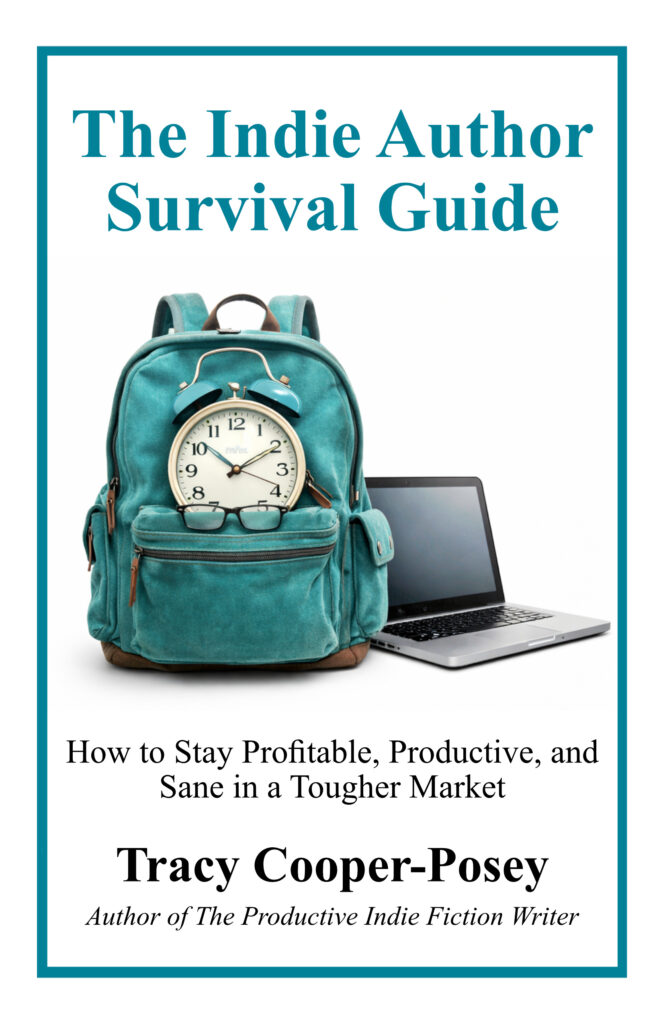
The Indie Author Survival Guide
How to Stay Profitable, Productive and Sane in a Tougher Market
Now Available.

The Productive Indie Fiction Writer: Strategies for Writing More, Earning More, and Living Well
Write More, Faster Than Ever Before | Are You Prolific?
Editing Your Next Novel? Mark Posey offers fast, writer-friendly edits with zero drama. Check out services »