Four years ago, Steve Davidson scared the crap out of me. In August 2022, Davidson, publisher of Amazing Stories, wrote a post called “The Coming Death of Commercialized Art.”
This was before ChatGPT was released to the public.
Davidson wasn’t primarily worried about AI-generated books flooding Amazon. He wasn’t talking about authors using AI to write faster, or publishers replacing writers with machines. He was looking further down the road.
His argument was that eventually we wouldn’t need commercially produced fiction at all. If you wanted a romance novel, you wouldn’t have to find an author who had written the sort of romance novel you wanted to read. You could simply ask an AI for it.
And if the result wasn’t quite right, you could change it. Different hero. More sex. Less sex. Older heroine. Make it funny. Make it darker. Put it in space. Give me dragons. Kill the sidekick. No, I liked the sidekick; bring him back. Whatever you wanted.
Davidson’s conclusion was brutal: “If your idea of an ideal life is writing romance novels for a living, you better find a day job.”
Then he went further. He didn’t mean the sort of day job that supports a writing career.
He meant another profession entirely. Because if readers could generate their own entertainment on demand, there would eventually be no commercial reason for someone else to spend months writing it for them.
I read the post in 2022. It frightened me. Then I got on with my life.
Four Years Later
Unfortunately, Davidson’s hypothetical reader is no longer entirely hypothetical.
In June 2026, researchers Neel Gupta, Maria Antoniak and Melanie Walsh published AI Fiction in the Wild. They studied more than 500,000 anonymized English-language ChatGPT conversations from the WildChat dataset.
More than a third involved some form of fiction generation: original fiction, roleplay, fanfiction, erotica, scripts, worldbuilding and other forms of storytelling.
The researchers identified users they called “infinite story demanders”: people who repeatedly requested and revised variations of similar stories over long periods.
They found demand for repetition, immediacy, familiar forms and extremely specific combinations of story elements. And they proposed a term that I haven’t been able to get out of my head: The solipsistic reader-writer.
The reader who guides the generation of fiction and consumes it in a closed loop. There is no human author on the other side of the transaction.
This study does not prove that conventional commercial fiction is doomed. The WildChat users aren’t a representative sample of the world’s book buyers, and we don’t know how many ordinary readers will ever want to generate their own fiction. But it establishes something important.
People are already doing the thing Davidson predicted.
And other researchers are looking at it, too. A 2025 paper presented at SIGDIAL, When a Dialog becomes a Monologue: A debate on custom-made literature with generative AI, specifically examines fiction generated by people primarily for their own consumption.
This is no longer just a thought experiment.
We’re Asking the Wrong Question
Most of the publishing industry’s discussion about generative AI has concentrated on production.
- Will AI-generated books flood Amazon?
- Should authors disclose their use of AI?
- Will publishers use AI instead of authors?
- Will AI-generated books be copyrighted?
- Will readers reject AI books?
- Will human authors have to compete against writers who can produce a novel every week?
All legitimate questions. But I’m starting to think they’re not the most important question. Because all of them assume that the book remains the product.
- Human author writes book.
- Or AI-assisted author writes book.
- Or AI writes book.
- Book is published.
- Reader finds book.
- Reader buys book.
- Reader reads book.
We’re arguing furiously about what happens at the production end of that chain.
Davidson was questioning whether we would continue to need the chain.
What Happens When the Reader Doesn’t Need the Book?
Imagine an AI capable of producing genuinely good long-form fiction. Not the vaguely competent, frequently generic material we’ve seen from generative AI so far. I mean fiction that is good enough that you enjoy reading it.
Now imagine telling it: I want a 90,000-word space opera with an older female captain, a morally ambiguous AI, found family, no romance, lots of competence porn, a nasty political problem, and an ending that makes me cry without being tragic.
Ten minutes later, there’s your book.
Perhaps you read three chapters and decide there’s too much politics. “Reduce the political plot and give me more of the AI.”
Done.
Perhaps you adore one particular character. “Write me another novel about her.”
Done.
Perhaps you finish the series and want another six books exactly like it.
Done.
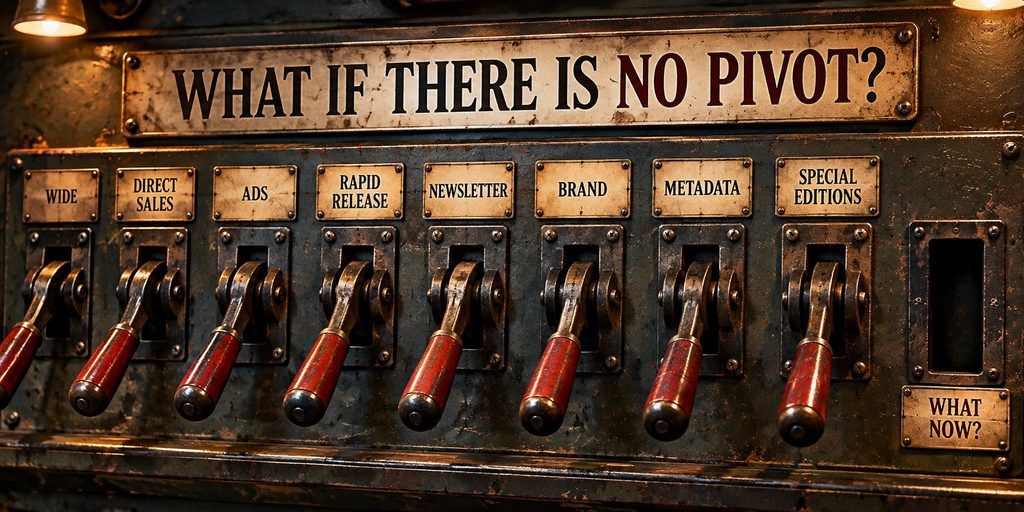
Now tell me what marketing strategy the commercial fiction writer uses to compete with that. That’s the part where I get stuck.
Indie Authors Always Find the Lever
I’ve been an indie publisher since 2011. One of the things I love about indie publishing is that when something changes, we adapt. Amazon changes the rules? Adjust. Advertising becomes too expensive? Find another way to reach readers. Retailers squeeze us? Sell direct.
Organic reach disappears? Build a mailing list. Discoverability becomes harder? Improve metadata, covers and positioning. Sales drop? Examine pricing, packaging, release schedules, genre, advertising, backlists and read-through.
There is always another lever. That’s practically the indie-author creed.
Okay. This isn’t working anymore. What can I change?
I’ve spent years doing exactly that. And I can’t find the lever for this one.
The Problem Isn’t AI Competition
If AI-generated commercial fiction becomes good enough, cheap enough and convenient enough, I don’t think our biggest problem will be competing against AI authors. Our problem may be that some readers no longer need authors at all.
That’s a completely different kind of disruption. You can compete against another author. You can compete against another book. You can improve your craft. Improve your covers. Build your mailing list. Develop a recognizable brand. Sell direct. Produce beautiful special editions. Build a community of devoted readers.
All of those things may continue to matter. There may remain a substantial market for fiction created by human beings. There may be readers for whom knowing another person imagined the story is an essential part of the experience.
I hope so.
But none of those strategies actually answers Davidson’s underlying question.
What happens if the customer no longer needs the product you’re selling?
I don’t know.
And I Hate Saying That
PIFW exists because I like useful information.
When something changes in publishing, I want to know what we can do about it.
I don’t particularly enjoy writing doom-and-gloom posts telling indie authors that everything is terrible and we’re all screwed.
If I’m going to tell you there’s a problem, I’d much rather follow it with: Here’s what I’m doing about it.
This time, I can’t. I haven’t found the answer yet. And I’m becoming increasingly suspicious of people who claim they have.
- “Build your brand.”
- “Develop authentic connections with readers.”
- “Create a community.”
- “Sell premium editions.”
- “Lean into what makes you uniquely human.”
Perhaps. Those may all be useful strategies. But they still assume there’s a sufficiently large population of readers who want to buy stories written by other people. That’s the assumption I’m examining.
This Is Personal for Me
I’ve been writing fiction professionally for decades. I’ve published more than 200 books. “Fiction writer” isn’t merely something I do. It’s part of how I understand who I am. So this isn’t an abstract discussion about technological disruption.
I’ve had to ask myself a deeply uncomfortable question: If commercial fiction ceased to be economically viable, would I keep writing it anyway? For the sheer artistic satisfaction of producing novels? I don’t know that I would.
I love stories. I’m not particularly interested in suffering for Art.
Writing a novel takes me weeks. It takes concentration, energy and hours upon hours of work.
If I were the only person who was ever going to read that novel, why would I spend ten weeks writing it when I could ask an AI to create a story specifically for me in ten minutes? Especially because then I wouldn’t know what happened next.
That thought bothers me more than almost anything else in this discussion.
Maybe We’re Solving the Wrong Problem
For years, whenever publishing changed, I asked: What do I need to do differently to keep making a living as a fiction writer?
- Write faster?
- Write slower?
- Change genres?
- Write longer series?
- Improve direct sales?
- Advertise differently?
- Build better reader funnels?
- Publish differently?
I’ve pulled a hell of a lot of levers.
Lately I’ve found myself asking a different question. What if making a living as a fiction writer isn’t the problem I should be trying to solve?
I don’t like that question. I don’t know what the answer is. And I’m certainly not suggesting that anyone abandon fiction because of what might happen. We don’t know whether personalized AI fiction will become mainstream. We don’t know how good it will become. We don’t know what readers will value when it does.
There are too many unknowns to make that prediction responsibly.
But we know something now that Davidson couldn’t know in 2022. Some people are already generating fiction for themselves. The behaviour exists. The technology is improving.
And I don’t think indie authors should refuse to look at the possibility simply because we don’t like where the argument leads. Nor do I think we should invent reassuring answers because every publishing article is supposed to finish with an actionable checklist.
So this one doesn’t.
I’m watching. I’m thinking. I’m questioning some assumptions I’ve held for a very long time. And for once, I haven’t found the lever.
Maybe there is one. I sincerely hope there is. But right now?
I don’t know.
Now Available.

The Anti-Ensh*ttification Field Manual for Indie Authors:
Because the platforms will decay…but your career doesn’t have to go down with them.
Now Available.
The Indie Author Survival Guide
How to Stay Profitable, Productive and Sane in a Tougher Market
Now Available.

The Productive Indie Fiction Writer: Strategies for Writing More, Earning More, and Living Well
Write More, Faster Than Ever Before | Are You Prolific?
Editing Your Next Novel? Mark Posey offers fast, writer-friendly edits with zero drama. Check out services »
Hmm. Some of my first thoughts are still predicated on AI being in its infancy, like “focus on food-heavy of sensory writing,” or expansion on “human-first” ideas already said.
“Emphasize customers wanting to support a human. Show yourself as a human to support that.”
I thought of adjacent industries – prompt coach, printer, AI maintainer.
Or the privacy appeal of creating something weird and specific that only you (and your AI partner) know about.. versus the appeal of someone else having already thought about it, possibly being into it, too, and creating something already-made. Less effort to create, maybe more effort to find. Just a title to leave a digital trail, as opposed to actual content/queries.
In terms of writing… the main thing I can think of is to write the things no one is thinking yet, or that everyone is thinking and doesn’t want to/doesn’t know how to say, or to address the prompts that people don’t know they want or don’t know how to ask.
So banking a little on human ignorance here, which isn’t great, or on building yourself as a prophet.
But that kind of foresight, a friend has told me, is based a lot on seeing patterns. And that is advantaged a lot by life experience.
So this is where being older can be helpful.
“How did you know that?” I asked my middle-aged mom once, after she was, once again, right.
“Because I am old.”
I like your mom. 🙂
Originality is the one true thing that meat-based authors can bring to the table. Is it enough to keep human-written commercial fiction alive?
I guess we’ll find out.
t.
I wonder how many people like to ‘make’ things. I’ve observed that many people don’t. They don’t get emotional fulfillment from the process of ‘making’, and would prefer to use their energy elsewhere and avoid the hard work of creating something–even when the work is facilitated by AI. (When you described how to craft a book with AI in the matter of minutes, you made assumptions based on your writer’s brain and muscle. But many people who aren’t makers can’t approach a story that way.) So, I hope there will always be people who prefer to consume what others make. But how will they consume? The ‘how’ will drive the author’s business model, and the answer to that question will reflect the preferences and practices of Generations Z and Alpha. So, more change is coming.
It is going to be interesting, I think, to see where we end up.
T.
You know my answer, Tracy 🙂
Double down on being human. Attract your 1000 true fans, and create for them. Multiple streams of income.
The mass market is over, for sure, and ‘audience of one content’ is already a thing, but you can make a living from a smaller group of people who want to support creators, who love what you do, and will buy what you make.
Thanks for stopping by, Jo. And yes, I knew exactly what your answer would be!
I think where I’m still stuck is one level underneath that. I agree that doubling down on being human, cultivating true fans and building multiple income streams is probably the strongest strategy we have right now.
What I don’t know is how large the future population of readers who specifically want to support human creators will be—or how many creators that population can economically sustain. I’m not yet confident enough to build an assumption of “there will always be 1,000 people willing to support me because I’m human” into my long-term planning.
Perhaps that’s really where you and I differ: you’re more confident than I am that the human relationship itself will retain enough economic value. I hope you’re right.
For now, I’m still watching, thinking—and looking for that lever.
Tracy