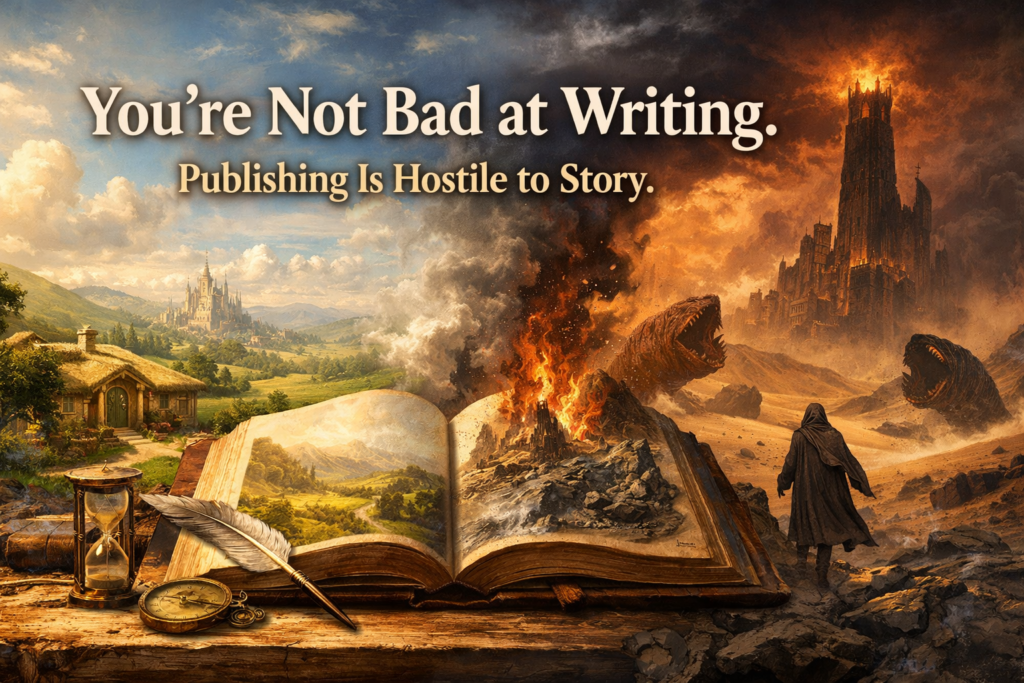
If you’ve been bouncing off books a lot, lately; even well written, competent, and award-winning books, and finding yourself thinking I just didn’t care, you’re not alone.
If you’re a writer, that reaction is worse. You start wondering:
- Have I lost patience?
- Have I lost my ability to read novels?
- Am I out of step now?
No. None of the above. What’s happening is simpler, and more uncomfortable. Storytelling itself has become unfashionable in parts of modern publishing.
What Story Actually Is
Let’s define terms, because this entire debate collapses without clarity.
Story creates problems to be solved.
That’s it. Everything else flows from that.
A story introduces a problem early. Often immediately. And always before the end of the first act. If it doesn’t reveal the main problem outright, it introduces a smaller one that inevitably leads there.
A story:
- moves forward through cause and effect (this happens, and then that happens because of it)
- forces choices
- escalates consequences
- exists in a world that pushes back (setting, characters, world structure all provide conflict stopping the main character from getting what they want)
- reveals character through what must be endured
Storytelling shows you what happened and asks, what will it cost to fix this?
If nothing is wrong, there is no story.
If this all sounds suspiciously like traditional three- or four-act story structure, you’re not wrong. The Hero’s Journey formalized the Quest, which can be stated another way: What does the character want? And what is stopping him from getting it?
A lot of modern, immersive fiction simply doesn’t bother with story goals, or they’re muted, delayed, or delivered as sub-text.
Stories Are Unsafe by Design
This is the part modern culture resists. In a world that is growing increasingly more stressful, filled with economic pressures, cultural rifts, environmental changes, global conflict and much more, readers can sheer away from fiction that delivers the same uncertainty.
Stories are dangerous. In a real story:
- people can die
- relationships can break
- the worst plausible thing can happen
A good storyteller doesn’t ask, What’s the gentlest path? They ask, What’s the worst thing that could happen—and what does the character do when it does? That risk isn’t cruelty. It’s the engine.
But many readers don’t want to trip over that unsettling aspect of a well-told story. I’ve had readers contact me before buying one of my books, to ask me whether anyone dies in this book, because I’ve killed off characters in the past.
I’ve curated anthologies where authors refused to include any conflict in their stories because they “don’t like conflict.”
That isn’t ignorance. It’s avoidance, because real stories require risk. And modern publishing has learned to deliver safety: Cozy fantasy, science fiction worlds where nothing really happens, contemporary fiction where the character spends the length of novel moving through their days and relating to friends and family.
What Publishing Now Calls “Immersive”
Traditionally, “immersive” fiction were stories that pulled the reader in and made them feel as though they could feel, smell and see the whole world. Many of my reader reviews talk about how the reader feels they are right there in the story.
Mary Stewart was brilliant at this old-fashioned (for now) type of immersive fiction.
Don’t mistake that sort of immersion for the modern form of “immersive fiction”.
Modern “immersive” fiction prioritizes something else:
- moment-to-moment consciousness
- emotional processing
- interior sensation
- relationships over events
- presence over progression
Nothing is wrong with this approach. Millions of readers looking for safe, comfortable reads have proved that.
But it isn’t story.
In many of these books, problems are minimized or deferred because problems disrupt experience. The goal is to stay inside the moment, not move through it. The result is often pleasant, skillful…and weightless. Talking heads in a void.
Arkady Martine’s Hugo Award winning A Memory Called Empire. Becky Chamber’s The Long Way to a Small, Angry Planet. Katherine Addison’s The Goblin Emperor. Ali Hazelwood’s The Love Hypothesis. These are all examples of immersive modern fiction. They are award-winners, best-sellers and fan favourites. They are tour de forces of experiential fiction.
They are not worse books. They are all well-written, sometimes lyrical in their prose. The imagination and creativity put into their worlds is staggering. But they are books pursuing a different goal: that of inhabiting experience rather than telling a story shaped by consequence. These books all delivered exactly what millions of readers wanted.
But readers won’t want this type of fiction forever. For these examples, above, read the negative reviews. Count the number that complain that “nothing ever happens” or decry the slow, slow pacing of the book.
Where This Shift Came From: Games, Not Books
The shift to modern immersive fiction didn’t happen by accident. Fiction absorbed values from games. Games reward players who linger. They provide side-adventures and environments where the player can spend hours tending a garden, picking out a wardrobe, building their house and petting the baby dragon.
Players can interact with other players and game characters. They can buy merchandise. Games are brilliant at keeping players inside their game world.
A whole generation of readers has learned to enjoy lingering inside a storyworld, and now expect the same immersive experience with their fiction. (It’s also why any successful story—in any medium—has fans begging for more. And more and more…)
But fiction’s superpower is different.
Games reward presence. Stories reward consequence.
When fiction borrows the feel of games without their mechanics, it produces books that are easy to stay inside…and hard to remember.
Cotton Candy vs Meals
Experience-first fiction dissolves quickly. It’s pleasant. Easy. Safe. Instantly consumable. And shortly after, you’re hungry again.
Storytelling is a meal. It takes longer. It asks more. It risks discomfort. But it leaves residue: images, moments, meaning.
Readers don’t reread cotton candy. They reread meals.
Immersion Isn’t the Enemy. Stasis Is.
This is where the argument often goes wrong. Immersion itself isn’t the problem.
Immersion must move the story. Period.
Immersion that doesn’t move the story is a luxury. You can afford it once, maybe. Build your whole book on it, and you’re serving cotton candy.
This is why immersive fiction done well still works. Frank Herbert’s Dune is one of the most immersive novels ever written. The immersion is the story. Every detail tightens the vise. Nothing exists merely to be interesting. Everything ramps toward consequence, culminating in a final line that lands because the story earned it: “History will call us wives.”
Likewise, Tolkien’s opening of The Lord of the Rings shouldn’t work by modern rules. A whole chapter on hobbits? Food, habits, genealogy? But Tolkien is doing story work. He’s showing what Frodo loves, and therefore what he will lose by choosing to destroy the ring. The Shire isn’t background. It’s stakes.
The story problem appears almost immediately. Frodo agrees he must leave, and then delays for weeks (in the book—movie time always compresses) because he doesn’t want to go. He’s torn from the outset. The story never stops moving, even when the characters hesitate.
A Necessary Exception: Tom Bombadil
The Tom Bombadil chapters resolve endless argument once you apply the rule. They have purpose. They orient the reader. They introduce the wildness and danger beyond the Shire. There is a reason Tom Bombadil and Barrow wrights and all the weirdness happens immediately after the four hobbits leave the Shire.
But those chapters do not move the story along. Which is why readers skip them on reread. Tolkien gets away with it once because the story is already in motion and the reader already trusts him. That’s the tolerance threshold.
Purpose without propulsion is survivable once. A whole book built on it is not.
“Let the Story Breathe” Is a Misdiagnosis
A contest judge once told me my book was moving too fast. She wanted time to “digest” what had just happened.
Nothing was inherently wrong with my story. The structure was sound. What was wrong was where I was standing. I was in the wrong room. The judges weren’t looking for story. They were looking for experience.
When someone says “let the story breathe,” that is often code for “stop delivering problems so I can stay inside the moment.”
They are different reader expectations.
And while millions of readers have been trained by games to seek immersive fiction that lets them linger in a pleasant and safe world that doesn’t challenge them the way real life does, there is an inherent emptiness in such reading, and after a while, readers start to notice it.
You can eat mountains of cotton candy, but it doesn’t satisfy the way a good meal does.
Why Readers Drift Away
Readers don’t articulate this consciously. They just stop reading. They abandon books. They reread old favorites. They read more and remember less. They keep returning to the trough because nothing satisfies them for long.
And eventually, they drift away from reading entirely. They don’t (and can’t) articulate why reading doesn’t please them anymore. They can’t figure out that finding books that tell stories will fix their hunger, because they can’t name what is wrong with the best-sellers and award-winners that they “should” enjoy. So they just…stop.
Story Requires Trust
Story demands trust. Readers must believe that the danger and unsettling events they must experience have a purpose. That the pain will mean something and the ending will pay off. They have to trust that the journey you are taking them on will be worth it.
Readers don’t trust stories. They trust storytellers. That trust is built book by book, ending by ending. And this matters for indie authors.
You Don’t Need to Sell Out
Storytelling will return to prominence. It always does. Humans crave meaning, not just sensation. Meaning requires problems, consequences, and resolution. Change. Experience alone cannot provide that indefinitely.
You do not need to slow your story to appease the wrong judges. You do not need to strip danger out of your work. You do not need to trade story for fashion.
Carry on telling stories.
Readers who want real stories are already looking, and more are getting hungry every day. Find them. Keep them close. Let them learn to trust you.
Story isn’t obsolete.
Now Available.

The Anti-Ensh*ttification Field Manual for Indie Authors:
Because the platforms will decay…but your career doesn’t have to go down with them.
Now Available.
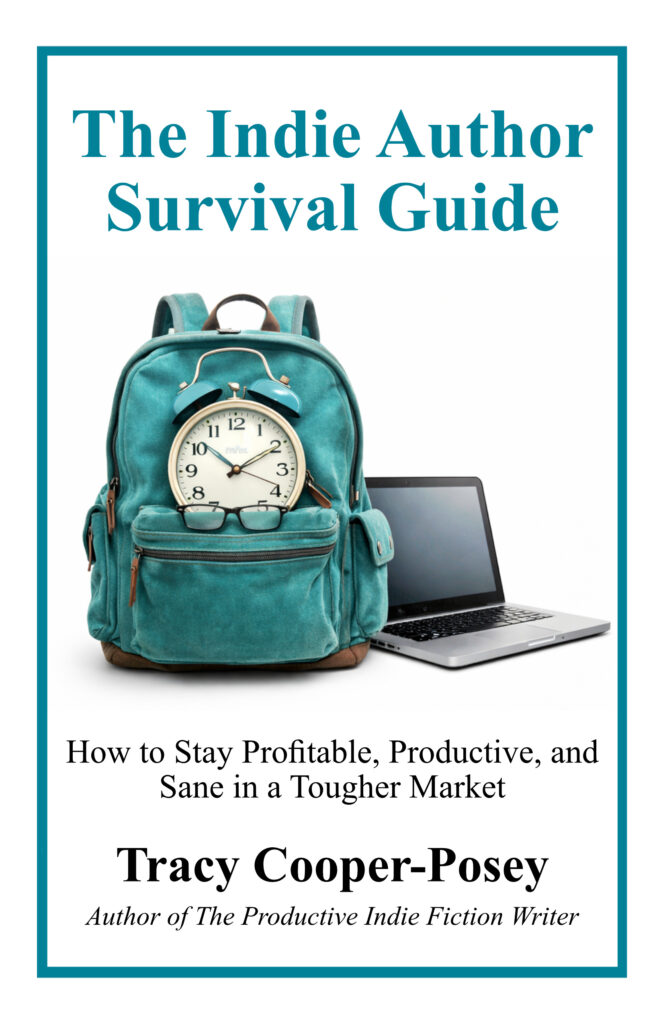
The Indie Author Survival Guide
How to Stay Profitable, Productive and Sane in a Tougher Market
Now Available.

The Productive Indie Fiction Writer: Strategies for Writing More, Earning More, and Living Well
Write More, Faster Than Ever Before | Are You Prolific?
Editing Your Next Novel? Mark Posey offers fast, writer-friendly edits with zero drama. Check out services »