
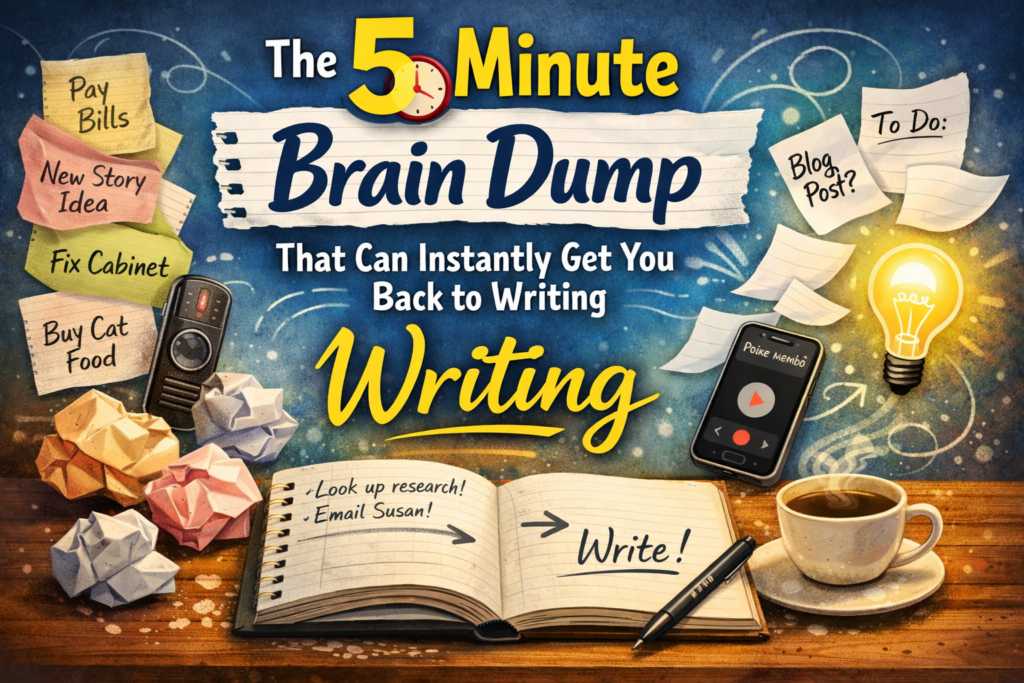
Writers are terrible at having just one thought at a time.
We sit down to write Chapter 12, and suddenly our brains decide this is the perfect moment to remember:
- you need to pay the power bill
- the kitchen cabinet has been broken for three years
- you should try that new sourdough recipe
- what if the villain secretly knew the heroine’s mother?
- you need a blog post idea for next Tuesday
- you should really redesign your newsletter signup page
- if Canada joined the EU, would we have to switch to Euros?
(Your brain: an enthusiastic toddler with a sugar high and no supervision.)
If you’re anything like me, you’ve spent your entire life asking questions and collecting ideas. Before Google, my father was the search engine of my childhood. Then I discovered libraries and the complete Encyclopedia Britannica. Then Google arrived. Now I pester ChatGPT with whatever random curiosity has burst into flame in my head.
But the questions are only half the problem. The other half is the endless parade of ideas. Book ideas. Promotion ideas. Blog post ideas. Character snippets. Recipes. Craft projects. Things to do today. Things to do tomorrow. Things that somehow create six more things.
Writers don’t usually suffer from a lack of ideas. We suffer from too many. And when all of them are bouncing around in your skull at once, it becomes almost impossible to focus on the manuscript in front of you.
Why Quieting Your Mind Matters
You cannot get into flow while your brain is standing behind you tapping you on the shoulder every twelve seconds.
“Don’t forget to email Susan.”
“What if the sidekick had a dog?”
“You need more printer paper.”
“Also, what is the exchange rate if Canada adopts the Euro?”
The noise matters because writing fiction requires concentration. To sink into the story, you need enough mental space to hold the scene, the characters, the emotional beats, the setting, the dialogue, and the next sentence.
When your brain is cluttered with reminders, errands, and shiny new ideas, part of your attention is always elsewhere.
You might still write. But it will feel harder. Slower. More fragmented. Like trying to sprint while carrying six grocery bags and a sack of potatoes. And it is flat out impossible to reach a flow state with all that noise in your brain.
Clearing your mind doesn’t just make writing easier. It often makes the writing better.
But first you have to recognize when mental noise is the issue.
The Sneaky Sign You’re Not Really Blocked
Sometimes we think we have writer’s block. We stare at the screen. We fiddle with the opening sentence. We decide maybe we need more coffee, more research, or perhaps a complete personality transplant.
But often the problem isn’t that you don’t know what to write. The problem is that your brain is too busy holding onto everything else. Part of your mind is still trying to remember:
- that task you mustn’t forget
- the idea you swear you’ll lose if you don’t capture it
- the thing you need to look up later
- the scene for another book that arrived at exactly the wrong moment
If you keep trying to hold all of that in your head while writing, your brain treats those thoughts like open browser tabs. And eventually there are fifty-seven of them, all playing music.
If you find you just can’t seem to write today, pause for a moment and examine what’s in your head. Is something niggling? Do you keep reminding yourself to remember?
The Brain Dump: How to Empty Your Head So You Can Write
The solution is wonderfully simple: Dump everything out of your brain and onto something else.
Paper. A note app. A voice memo. A text file. The back of an envelope. Whatever is handy.
The goal is not to organize it. Not yet. This is not the tidy, color-coded, productivity-guru phase. This is the glorious, messy, get-it-out-of-your-head phase.
Write down every nagging thought, task, reminder, question, and idea. Everything.
- buy cat food
- chapter idea: villain knows the truth
- email newsletter
- fix cabinet
- look up medieval funeral customs
- blog post about brain dumping
- remember to switch laundry
- is there cinnamon in the pantry?
- what do Euros look like, anyway?
Don’t judge the thoughts. Don’t organize them. Don’t decide whether they’re important. Just get them out.
Once your brain trusts that the thought has been captured, it stops clutching it like a toddler hanging onto a sticky lollipop.
Ways to Brain Dump
There is no correct system. The correct system is the one you will actually use.
If you’re an analog person, use:
- a sheet of paper and a pen
- a notebook
- sticky notes
- the nearest receipt from your purse
If you’re digital, try:
- a text document
- a notes app
- a task manager
- a voice memo on your phone
- sending yourself a text message
Personally, I have half a dozen capture systems because ideas have the survival instincts of squirrels and will flee the second you look away. The important thing is to capture the thought immediately. Because otherwise your brain will keep whispering, “Don’t forget. Don’t forget. Don’t forget.”
And you won’t.
You will forget everything except that you’re trying not to forget.
The Advanced Move: Dump It Right Into the Manuscript
This is my favourite trick for stubborn thoughts that refuse to leave me alone. You’re writing. An idea barges in. Or a reminder. Or something you absolutely cannot lose. Instead of leaving your manuscript and vanishing into the productivity wilderness for forty-five minutes, write the thought right there in the document.
For example:
[Remember to look up whether cedar trees grow in northern Alberta.]
[Blog idea: writers need brain dumps.]
[Promotion idea: newsletter sequence for new readers.]
Then shove it below the cursor and keep writing. Let it sit there quietly while you finish the scene. You’ve acknowledged the thought. You’ve captured it. Your brain can stop waving it around like an emergency flare.
This is the advanced-level version of, “I refuse to be distracted today.”
Brain Dumping Is Not the Final Step
The brain dump is the middle step, not the end. If you’re familiar with Getting Things Done, this is the capture stage before you process everything properly.
Once you’ve finished writing—or at least reached a stopping point—take your brain dump and move the items into whatever system you use:
- your inbox
- your task manager
- your notebook
- your calendar
- your ideas file
- your someday/maybe list
Sort them later. The only job of the brain dump is to get the clutter out of your head so you can get back to work.
The Strange Little Magic of an Empty Mind
When you’ve dumped everything out, something shifts. The mental static quiets down. The reminders stop poking you. The shiny ideas settle into the background because they know they’ve been safely captured.
And suddenly, you can concentrate again.
You can sink into the story. You can write.
It feels oddly magical, this simple act of emptying your mind onto paper. Not hypnosis, exactly. Just giving your brain permission to stop carrying every thought at once.
Your mind is a wonderful place for creating ideas. It is a terrible place for storing them.

Now Available.

The Anti-Ensh*ttification Field Manual for Indie Authors:
Because the platforms will decay…but your career doesn’t have to go down with them.
Now Available.

The Indie Author Survival Guide
How to Stay Profitable, Productive and Sane in a Tougher Market
Now Available.

The Productive Indie Fiction Writer: Strategies for Writing More, Earning More, and Living Well
Write More, Faster Than Ever Before | Are You Prolific?
Editing Your Next Novel? Mark Posey offers fast, writer-friendly edits with zero drama. Check out services »