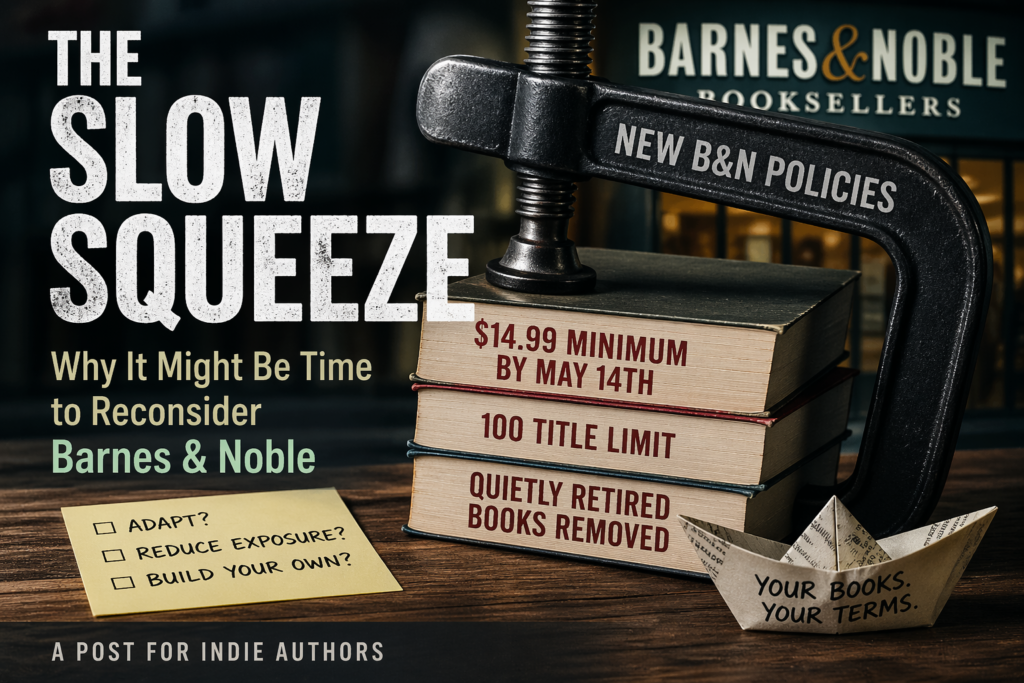
It started, as these things often do, with a notice on my B&N dashboard. Not dramatic. Not loud. Just very clear. Raise your paperback prices to $14.99 USD or higher by May 14th. If you don’t, your books will be removed.
Not “may be.” Not “could be.” Will be.
On its own, that would be a significant change. For many indie authors—especially those working in short fiction—it effectively makes certain formats non-viable in print. But it doesn’t exist in isolation. In recent months, Barnes & Noble has also:
- Imposed a 100-title cap for indie authors (this one is flexible, but does require negotiation)
- Quietly “retired” books that weren’t meeting performance expectations
- In some cases, failed to notify authors those titles had been removed
Taken together, these aren’t minor adjustments. They’re pressure. And it’s all pushing in the same direction.
What’s Actually Changing
A $14.99 minimum for paperbacks doesn’t just “encourage” different pricing. It eliminates entire categories of indie publishing from the platform. Short stories. Novelettes. Many novellas. Not because readers suddenly value them differently, but because they cannot realistically be priced at that level and still sell.
Even traditionally published imprints like Tor.com, with established branding and market positioning, don’t routinely price shorter works this way.
This isn’t about aligning with industry norms. It’s about enforcing a model that only works for certain types of books.
Who This Hits (And Who It Doesn’t)
If you’re an indie author who:
- Writes across multiple lengths
- Publishes frequently
- Maintains a deep backlist
…you’re directly in the path of these changes.
If you’re:
- Publishing a handful of full-length novels
- Releasing infrequently
- Operating within traditional retail expectations
…you may barely notice.
That difference matters, because it highlights the real issue: a growing mismatch between indie publishing models and platform constraints.
The Bigger Pattern: The Slow Squeeze
There’s a term for what’s happening here: enshittification. At its core, it describes a familiar arc:
- A platform opens up to attract creators
- It grows by being useful and accessible
- Then it tightens control to optimize margins and operations
What we’re seeing now isn’t a sudden break. It’s the later stages of that curve. Policies shift. Quietly. Incrementally. Each one, on its own, is explainable. Together, they form a pattern: Less flexibility. Less tolerance for edge cases. Less room for creators who don’t fit a narrowing mold.
Whether intentional or not, the outcome is the same: A specific class of author—high-output, wide-ranging indies—finds itself increasingly squeezed.
The Strategic Question: Are You Building on Rented Land?
Here’s the part worth paying attention to. A single policy change now has the power to make large portions of an indie author’s catalog non-compliant, on a fixed deadline. No negotiation. No nuance. Just: comply or be removed.
That’s not a discovery issue. That’s not an algorithm problem. That’s structural dependence on a platform that can redefine your business model with one email.
Barnes & Noble isn’t your store, and moments like this make it very clear whose rules you’re operating under.
Your Options (None of Them Perfect)
So what do you do? There isn’t a one-size answer—but there are a few clear paths.
1. Adapt to the platform
You can bundle shorter works into larger collections, raise prices to meet thresholds and curate your catalog down to 100 titles. This keeps you compliant—but at the cost of flexibility, and possibly at odds with your readers.
2. Reduce your exposure
Treat B&N as a secondary channel. Keep only select titles available. Focus on works that naturally fit their constraints. This reduces your risk. It also reduces your reach.
3. Build something you control
This is the long game—and the anti-enshittification play. Sell your books directly. That doesn’t require a full ecommerce empire. It can be as simple as one book, one page, one payment button.
If a reader can buy from you without a platform standing in the middle, you’ve already reduced your risk, because you control the pricing, the format and the availability. You are also no longer vulnerable to quiet retirements, arbitrary caps and price enforcement.
So… Time to Cut and Run?
Not necessarily. But it is time to decide. Just don’t decide reactively, when the next email lands, or when a chunk of your catalog disappears. Figure it out now. Ask yourself what happens if you’re limited to 100 titles? What happens if your pricing model stops working? What happens if a platform you rely on changes again?
If those answers make you uncomfortable, that’s your signal that you really need to take action now.
A Few Practical Steps
You don’t need to overhaul everything overnight. Start small:
- Audit your catalog: what still works under these rules?
- Identify your “core” titles
- Set up a basic direct sales option (even minimal)
- Begin training your readers to buy from you
You’re not abandoning platforms. You’re reducing your dependence on them.
Don’t Wait for the Next Email
The problem isn’t that Barnes & Noble changed the rules. It’s that they can change the rules in a way that forces you to either restructure your catalog, reprice your work beyond what readers will pay or remove your books entirely. And they can do it on a deadline.
You don’t need to panic. But you do need a plan. Because the next email will not give you back any control. It will take even more from you.
Now Available.

The Anti-Ensh*ttification Field Manual for Indie Authors:
Because the platforms will decay…but your career doesn’t have to go down with them.
Now Available.
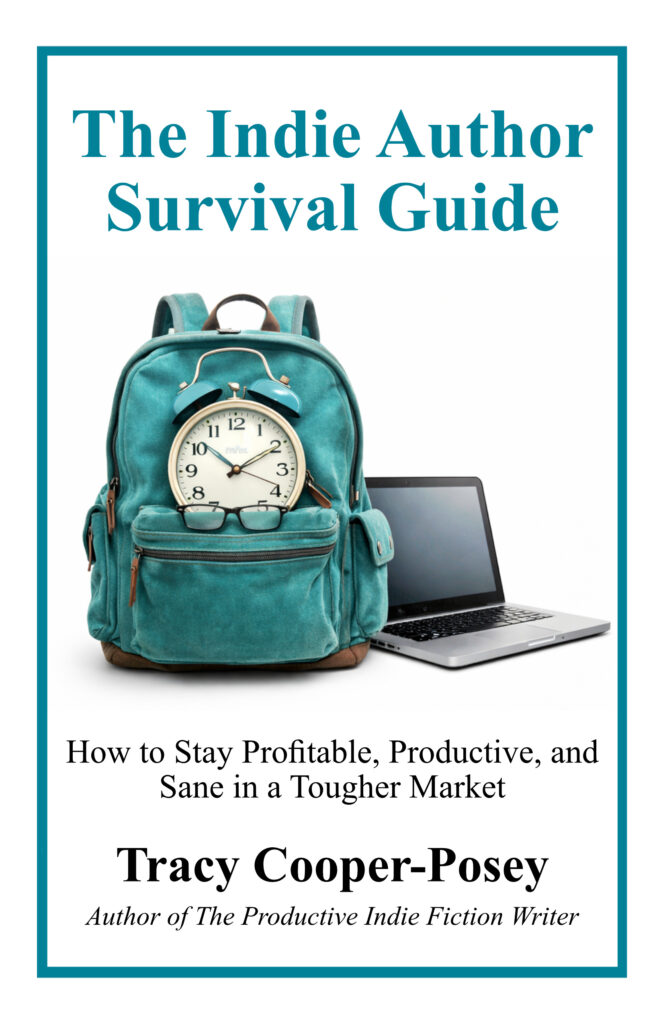
The Indie Author Survival Guide
How to Stay Profitable, Productive and Sane in a Tougher Market
Now Available.

The Productive Indie Fiction Writer: Strategies for Writing More, Earning More, and Living Well
Write More, Faster Than Ever Before | Are You Prolific?
Editing Your Next Novel? Mark Posey offers fast, writer-friendly edits with zero drama. Check out services »