A few days ago, I had almost the entire day available for writing. This doesn’t happen very often. I was working on Rogue Star, the next book on my production schedule, and with that much uninterrupted time available, I should have had an excellent writing day.
I wrote 7,000 words.
Now, before you throw things at me: I know perfectly well that 7,000 words is a spectacular writing day for many writers. It isn’t for me. Not when I have nearly the entire day available to write. I write fast when I’m properly immersed in a book, and 7,000 words after a full day of writing told me that something was wrong.
The next morning, I figured out what it was. I couldn’t remember why I wanted to write the book.
When the Book Becomes a Rock in Your Day
I don’t mean I had lost my enthusiasm for writing. That’s a different problem. Nor did I actively dislike Rogue Star or want to abandon it. I just couldn’t remember what had made me excited about this particular story.
I knew, of course, why I was writing it. It was next on the production schedule. Readers were waiting for it.
Those are perfectly good reasons to finish a book. They’re lousy reasons to be excited about writing one.
When I thought about Rogue Star, all I could see was the work involved. The pacing seemed slow. The story didn’t feel terribly exciting. I couldn’t clearly remember the highly emotional material coming later in the book. I’d lost track of the scene I had been particularly looking forward to writing.
Meanwhile, everything else in my life was pressing down on the tiny spark of desire I still had to write the book. Instead of being the thing I wanted to spend the day doing, the book was beginning to feel like a rock sitting in the middle of my day that I kept tripping over while trying to juggle everything else.
That’s when I realized that I hadn’t lost my enthusiasm for the book. The book had fallen out of my head.
How a Book Falls Out of Your Head
When I outlined Rogue Star, I expected to start writing it and continue until I reached the end. Instead, about 20,000 words into the manuscript, I stopped. Another book in a completely different series needed to be written, and it took me away from Rogue Star for weeks.
I hadn’t anticipated that interruption when I wrote the outline.
The outline was perfectly adequate for the job I expected it to do: guide me through a book I was writing continuously, while all the nuances, connections, emotional arcs and clever little ideas remained fresh in my mind.
It wasn’t designed to bring me back into the book after I’d spent weeks living inside a completely different story.
This can happen even with a book you know extremely well.
Rogue Star features Danny Andela, a protagonist I’ve been writing for fifteen books. I know Danny backwards. That didn’t help nearly as much as you might expect.
I hadn’t forgotten Danny. I’d forgotten Danny in this story.
I’d lost the web of meaning surrounding the events of this particular book: why something mattered now, what Danny was carrying into a scene, what was building beneath apparently minor events, where the emotional pressure was heading, and what all of it was eventually going to collide with.
I knew the broad strokes. The broad strokes weren’t enough.
A New Book Has a Different Advantage
Oddly, I think this particular problem can be worse when you’re deep into an established series than it is with a standalone novel or the first book in a series. With a new book or series, everything is fresh. The original concept work probably happened fairly recently. You can still remember the moment when you thought, Oh, I really want to write this.
The characters are still forming. The world is new. You’re discovering things as you write. Novelty is doing some of the work of keeping you engaged.
Rogue Star, on the other hand, belongs to a second spin-off series in a story universe I’ve been writing for years. The characters are solid. The world is solid. The series is simply there. That’s enormously useful—until familiarity makes the things you once loved about the series almost invisible.
The original creative work that made you excited about these characters may have happened years ago. If you’re pulled away from the current book for long enough, you can lose not only the finer details of this particular story, but your immediate connection to the joy of the larger series.
You don’t need to rediscover the characters. You need to rediscover why you’re enjoying telling this story about these characters now.
Don’t Just Reread the Outline
My first instinct was to reread my outline. That wasn’t enough. Passive reading can give you the illusion that you’ve remembered the story. You read a point and think, Yes, yes, I remember that.
Then you move to the next point.
At the bottom of the outline, you know what happens, but the book still isn’t properly alive in your head.
What worked for me was working on the outline. I tweaked it. I expanded points that had become too cryptic. I clarified things. I shifted material around.
I looked at the cause-and-effect chains and made sure I understood not merely what happened next, but why it happened and what it meant to the characters. Most importantly, I filled in the holes.
Beware of Past You
When we’re immersed in a book, we all write outline notes that make perfect sense at the time. Sometimes we don’t write the note at all. I don’t need to put that in the outline. I’ll remember THAT.
Past You is adorable. Past You has apparently never met Future You after several weeks away from the book.
Sometimes the hole was deliberate. I knew approximately what needed to happen and assumed I’d figure out the details when I reached that point. Sometimes I clearly had something more specific in mind when I wrote the outline, but whatever it was had vanished.
If that happens, don’t spend hours trying to reconstruct the outline that originally existed in your head. It’s gone. Fill the hole using what you know about the story now.
You have an advantage the original outliner didn’t have: you’ve written part of the manuscript. You know the characters in this particular story better. You’ve seen which ideas actually worked on the page. New possibilities may have appeared.
The replacement idea may be better than the one you’ve forgotten.
Your job isn’t to restore the original outline. Your job is to create the best outline for the book you’re writing now.
Pick Up the Story Strings
This is why tweaking the outline matters so much. When you actively work on it, you start picking up the story strings again. You notice that one event depends upon another. You remember why a character doesn’t yet know something. You realize a reveal needs to move.
You see that something happening three chapters from now needs setup in the scene you’re about to write. You remember that the apparently minor conversation over here is going to become horribly important over there.
The book starts becoming three-dimensional again.
This also means restoring the emotional logic, not merely the plot. There’s a tremendous difference between:
Danny discovers X.
and:
Danny discovers X. Because of what happened earlier, she believes it means Y.
That pushes her into doing Z—and she doesn’t yet know Q.
You don’t need to turn your outline into a novel about your novel. A few words may be enough. But you need enough information to recover why the events matter. Without that meaning, an outline can look like:
Event → event → event → event.
Of course that feels slow. But once you restore the meaning, you’re seeing:
Pressure → consequence → worse pressure → revelation → disaster.
That’s a story.
Find THE Scene
While you’re rebuilding the outline, look for the scene. You know the one. It’s the scene you’re impatient to write.
It doesn’t have to be the climax. It might be a confrontation, a revelation, an emotional payoff, a spectacular piece of action, a tiny conversation you’ve been anticipating for half the book, or the moment when a character finally discovers something the reader has known for chapters.
Find the scene that makes you think: Oh, yes. I want to get THERE. Then the scenes you’re writing now aren’t simply more words you have to produce. They’re taking you somewhere.
Use Your Other Reloading Tools
Once you’ve started reconstructing the story, anything that reconnects you with the book can help.
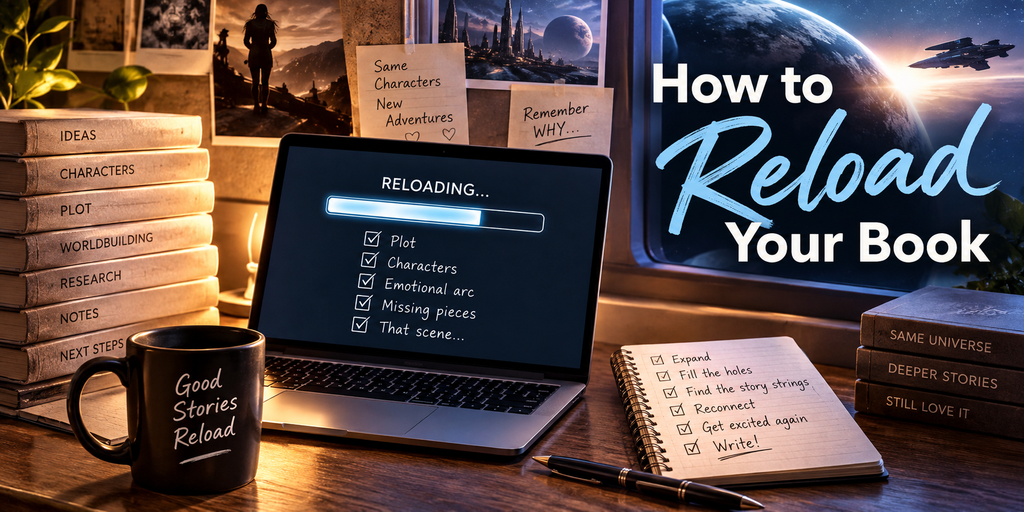
For me, that can include looking at the mood board. That may sound a little woo-woo, but it isn’t. The images I collected when I was developing the book are associated with the world and the story in my head. Looking at them helps bring back the texture that an outline can’t provide.
Your equivalent might be a playlist, research photographs, character images, the cover concept, original development notes, or something else entirely.
You might also reread a scene from the manuscript that you particularly like. Not necessarily the last scene you wrote. If you’re already doubting the book, rereading your most recent work can turn into an editing session or an invitation to criticize yourself.
Pick something that feels unmistakably like this book. Remind yourself what it feels like when it’s working. If you’re deep into a long-running series, you may also need to reconnect briefly with the series itself. Look at old covers. Read your original series premise. Revisit a favourite scene. Read something that reminds you what readers love about these characters.
You’re not embarking on a three-day spiritual retreat to rediscover your muse. You’re supplying your brain with retrieval cues.
Don’t Diagnose a Book You Can’t Remember
This may be the lesson I most needed. When I realized something was wrong, I was already starting to make judgments about Rogue Star.
- The pacing was too slow.
- The story wasn’t exciting enough.
- Maybe something was structurally wrong.
Except I couldn’t clearly remember the exciting material that was coming. I had temporarily lost the emotional and causal connections that made the current scenes meaningful.
This was a spectacularly bad time to diagnose the manuscript.
If the book still feels slow after you’ve reloaded it, pay attention. You may genuinely have a pacing problem. But don’t make major structural decisions while you’re disconnected from the story.
First reload the book. Then decide whether it’s broken.
Take the Time It Takes
This may be the hardest part for a professional writer. You’re behind. The book is on the production schedule. Readers are waiting. You finally have a day available for writing.
And I’m suggesting that you spend an hour—or two hours, or half the morning—not writing.
Do it anyway. Don’t rush the reloading process because the deadline is screaming at you. And don’t decide in advance that you’ll give yourself exactly thirty minutes to look through the outline before you MUST START PRODUCING WORDS.
You’re not completing a checklist. You’re trying to achieve a state. You want to reach the point where the whole book is alive in your head again.
You’ll know when you’re getting there. You’ll start seeing connections. You’ll add things to the outline because new ideas are occurring to you. You’ll spot setups and payoffs.
You’ll start anticipating scenes instead of merely remembering that they’re next. Eventually, you may become impatient with the outline because you want to get back to the manuscript.
That’s your book, reloaded.
Reloading Is Not Wasted Writing Time
This was the argument I particularly needed to make to myself. I’d already tried pushing through. Remember that nearly empty writing day? Seven thousand words. Again: perfectly respectable output for many writers. Poor output for me under those circumstances.
I had already demonstrated that giving myself more hours wasn’t solving the problem.
When I’m fully immersed in a book, I write quickly. When I’m dragging myself through a story that isn’t properly loaded into my head, I slow down. I hesitate. I reread. I question things. I wander down paths that may have to be fixed later.
So spending two hours reloading the book may give those two hours straight back to you in writing speed. It may give you more. It may not. That’s not actually the point.
If you write better scenes, enjoy writing them more, avoid unnecessary revision, and sit down tomorrow with the entire book still humming in your head, the time wasn’t wasted. It was part of writing the book.
And Did It Work?
I’m writing this part a few days later. Rogue Star is finished. Once I had worked through the outline, filled the holes and sorted out the rest of the plot, the book rolled along nicely.
Which also answered the question that had been bothering me when I started this process. Was the book actually slow and unexciting?
Apparently not.
I had been trying to judge a story I couldn’t properly remember. The problem wasn’t that I’d stopped wanting to write. It wasn’t that I’d suddenly forgotten how to write Danny. It wasn’t necessarily even that Rogue Star had a pacing problem.
I’d been pulled away from the manuscript for weeks, and too much of the working version of the story had fallen out of my head. I needed to put it back.
So the next time you’ve been away from a manuscript and returning to it feels strangely heavy, don’t immediately assume you’ve lost your enthusiasm for the story. And don’t necessarily respond by putting your head down and forcing yourself to produce words.
Stop.
Reload the book.
And take as long as you need to do it properly.
Now Available.

The Anti-Ensh*ttification Field Manual for Indie Authors:
Because the platforms will decay…but your career doesn’t have to go down with them.
Now Available.
The Indie Author Survival Guide
How to Stay Profitable, Productive and Sane in a Tougher Market
Now Available.

The Productive Indie Fiction Writer: Strategies for Writing More, Earning More, and Living Well
Write More, Faster Than Ever Before | Are You Prolific?
Editing Your Next Novel? Mark Posey offers fast, writer-friendly edits with zero drama. Check out services »
Interesting! I’ll keep this in mind as I may face a similar situation soon. I was writing the 6th book in a series of interconnected standalones when all of a sudden my creative voice insisted I start writing the 7th (featuring a 1/2 sister of book 6’s MC). Then my creative voice insisted I stop writing book 6 and finish writing book 7 first. Only after a few weeks (I obeyed, of course) did I realize that’s because book 7 takes place in a shortened timeframe within the span of book 6 and there’s an event that needs to have some impact on the 2nd half of book 6. My creative voice just didn’t feel like explaining that upfront!
Yes! This is the perfect use-case for needing to reload a book; if you moved between books, picking up one then moving to another, then going through a reloading process when you go back to an already-started book would get you off to a flying re-start. 🙂
I usually finish one book before starting the next, so “dropping” a book mid-book underlined how much one does need to reload a book, when they get back to it.
Good luck with your books 6 and 7!
Tracy