I recently came across a discussion about Steven Erikson’s Malazan Book of the Fallen series, and the difficulties some readers have getting into it. One piece of advice was particularly startling: Skip the first book.
I have tried to read Gardens of the Moon, the first Malazan novel, twice. Both times, I made it perhaps fifty pages in before putting it aside, so I understood where the advice was coming from. But it raised a question I’ve been turning over ever since: How difficult can commercial fiction afford to be?
Except the more I thought about it, the less useful the word “difficult” became.
Is It Actually Difficult?
There are plenty of Malazan readers who don’t consider Gardens of the Moon difficult at all. And they’re not necessarily being macho about it. Perhaps, for them, it genuinely isn’t.
I remember reading Dune when I was fourteen and struggling with it. Not with the prose, particularly. I struggled with the concepts and everything Frank Herbert expected me to absorb. I was fascinated enough to persist, but I had to grow into Dune. I was a different reader when I returned to it later.
Does that make Dune a difficult novel? I’ve rarely heard it described that way.
And my experience with Gardens of the Moon was different again. I could understand what I was reading. The problem was the amount of attention I needed to give it. There were characters, factions, history, worldbuilding and events I needed to keep straight, while Erikson wasn’t particularly interested in stopping to make sure I’d caught up.
At the time, I simply didn’t have the spare mental bandwidth to do that. It didn’t help that Malazan is grimdark with a vengeance, and grimdark is something I generally avoid. The reward I was likely to get from investing all that attention wasn’t high enough, for me, to justify the effort.
Another reader might make exactly the opposite calculation. Which suggests that “difficulty” isn’t entirely a quality of the book. It exists partly in the relationship between the book and the reader.
A fourteen-year-old reader may struggle with a book the same person devours at forty. An experienced fantasy reader may effortlessly process conventions that completely bewilder a newcomer.
A reader on holiday with three uninterrupted hours might happily tackle a sprawling cast and complicated world. The same reader, exhausted after work and grabbing twenty minutes before bed, may not.
And a reader who adores exactly what a book is offering will tolerate considerably more effort than someone who is only mildly interested.
So perhaps the better concept isn’t difficulty. Perhaps it’s reader workload.
We’ve Learned How to Read Stories
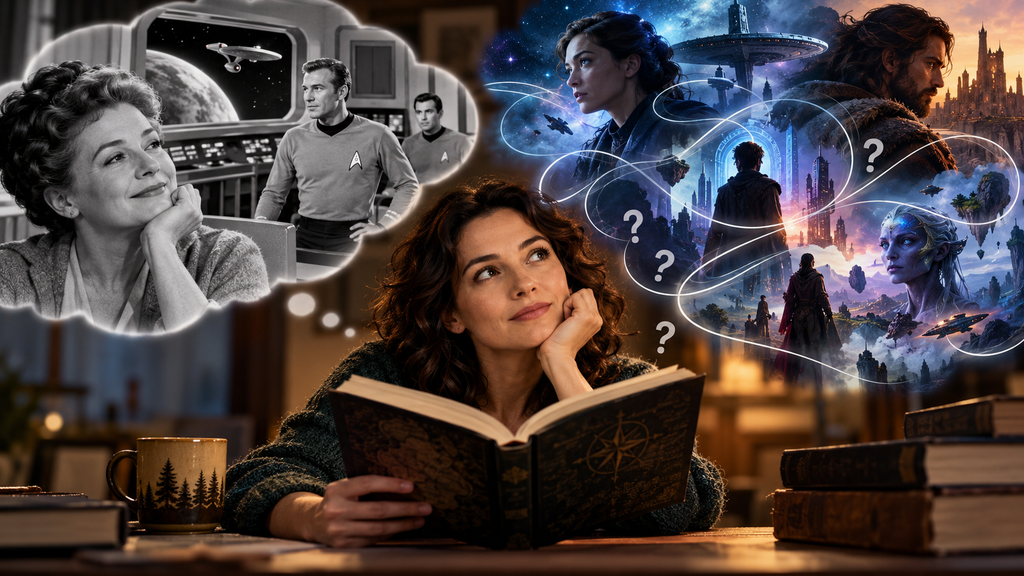
I’ve noticed something similar while watching old movies and television. Watch television from the 1960s now and the pacing can feel almost somnambulistic. Part of that is simply changing tastes, but part of it is the language of television itself.
Older television often explained everything. There were establishing shots. Long reaction shots. Characters travelled from one place to another on screen. Scenes carefully oriented the viewer before getting down to business.
An episode of the original Star Trek generally had one main storyline and took its time telling it. Compare that with modern television.
The episode of Star Trek: Strange New Worlds I watched last night had A, B and C storylines running simultaneously. It moved rapidly between them. Characters simply arrived where they needed to be. The camera didn’t linger to explain transitions that the audience could infer for itself.
Modern audiences don’t need to see the Enterprise travel from A to B. We understand the cut. We’ve learned the language. Storytellers can therefore leave out information that earlier storytellers had to provide.
And that means modern storytelling can become denser without necessarily becoming more difficult. The audience is doing more of the work.
But Not Every Audience
My mother cannot watch modern science fiction. She simply doesn’t understand what’s going on. If she sees people stand on a plastic circle and disappear, she doesn’t then infer that “oh it’s a teleportation device” and that when they are somewhere else in the next scene (these days, we don’t always get to see them arriving somewhere, either), it’s because they were transported there.
Yet I strongly suspect I could sit her in front of an episode of the original Star Trek and she would follow it perfectly well. That gave me pause.
Perhaps modern fiction hasn’t simply become faster. Perhaps it increasingly assumes genre literacy. A regular science-fiction viewer already understands an enormous amount before the story begins. Artificial intelligence. Faster-than-light travel. Alternate timelines. Cloning. Uploaded consciousness. Parallel universes. First contact.
The storyteller can mention one of these concepts, give us a few contextual clues and move on. We fill in the rest.
Genre readers do exactly the same thing.
An experienced fantasy reader doesn’t need a careful explanation of what a mage is. They know why the king’s illegitimate child might be politically dangerous. They understand that the ancient sword discovered in the tomb probably isn’t there for decoration.
Mystery readers know how clues work.
Romance readers recognize the narrative significance of a second plausible romantic partner.
Science-fiction readers bring decades of accumulated concepts and conventions to every new book.
We aren’t merely reading the story the author put on the page. We’re supplying information from all the stories we’ve already consumed. That is an extraordinarily powerful tool for writers. It can also shut the door in a newcomer’s face.
Who Must Your Reader Be Before Page One?
This, I think, is where the question becomes useful for writers. How much genre literacy does your book require? More importantly: Who must the reader already be before page one for your book to work?
That’s a decision. It may not always be a conscious decision, but perhaps it should be.
If you’re writing for someone who has been reading epic fantasy for thirty years, you can assume a great deal. In fact, stopping to explain every familiar convention may drive that reader crazy. They already know this stuff. Skip it.
Use the space and the reader’s attention for something more interesting.
But perhaps you’re writing for the person who enjoyed The Lord of the Rings movies and has decided to try an epic fantasy novel for the first time. That reader needs a different doorway.
Neither choice is inherently superior. The problem comes when you don’t know which choice you’ve made. There’s a significant difference between:
“This book assumes considerable familiarity with epic fantasy because I’m writing specifically for experienced epic-fantasy readers.”
And:
“I didn’t realize newcomers couldn’t follow it.”
One is positioning. The other may be a craft problem.
So What Is Commercial Fiction?
Which brings me back to the question that started all this. Can dense, demanding fiction legitimately be called commercial fiction? I think the answer depends upon what we mean by “commercial.”
We’ve traditionally associated commercial fiction with accessibility. Strong narrative drive. Recognizable genre conventions. Emotional engagement. A story designed to reach a substantial paying readership.
That made perfect sense under traditional publishing. A publisher putting a novel into thousands of bookstores wanted as many potential buyers as possible. Anything that unnecessarily narrowed the audience was a commercial risk.
Indie publishing inherited much of that thinking. Then the Amazon era intensified it. Immediate hooks. Familiar tropes. Rapid releases. Covers that communicate genre in a fraction of a second. Books optimized for read-through.
Reduce friction everywhere.
There is nothing inherently wrong with any of that. But the commercial equation is changing. An independent author doesn’t necessarily need a book that appeals moderately well to an enormous audience. They can build a viable career by appealing intensely to a much smaller one.
In that environment, a demanding book can be entirely commercial. The important question isn’t whether the reader has to work. It’s whether the intended reader enjoys the work you’re asking them to do.
Mystery readers work to solve the puzzle. Hard-SF readers may enjoy wrestling with technical ideas. Epic-fantasy readers may love piecing together enormous histories and political systems. Malazan readers may positively relish being dropped into a world that refuses to stop and explain itself.
The effort isn’t necessarily an obstacle to the experience. Sometimes it is the experience.
Then AI Walks Into the Room
And this is where the question becomes particularly interesting for the New Indie Author. I’ve been arguing for some time that one response to generative AI is to write books AI can’t.
AI can produce competent genre fiction. And it is particularly comfortable working with recognizable patterns: familiar structures, familiar tropes, familiar narrative solutions.
That makes competing by producing increasingly frictionless, broadly acceptable, conventionally satisfying fiction a questionable long-term strategy for human writers.
We have another option. We can become more specific. More idiosyncratic. We can trust readers more.
We can leave things unexplained. We can pursue strange interests. We can use unusual structures and write books requiring knowledge, inference, attention or emotional participation.
We can make choices that some readers will dislike intensely because those same choices make other readers say: Nobody writes books like this.
For a New Indie Author, that may be one of the most commercially valuable reactions a book can generate. But there’s a trap here.
Don’t Confuse Genre Literacy With Intelligence
“Trust the reader” doesn’t mean “assume the reader already belongs to the club.”
If we strip away every explanation because experienced genre readers don’t need it, we may create fiction that only existing genre readers can enter. Genres can become increasingly self-referential as they mature.
Writers read the genre. Editors know the genre. Reviewers know the genre. Core readers may have consumed hundreds of books in it. Everyone involved becomes extraordinarily fluent in its conventions. The storytelling can therefore become increasingly compressed.
Until a newcomer wanders in and has no idea what everyone is talking about.
That isn’t necessarily a problem—if you decided that newcomer isn’t your reader. But it should be a decision. The New Indie Author gets to choose how high the threshold is.
You might deliberately write extraordinarily sophisticated science fiction with a low barrier to entry. Or you might write fantasy specifically for readers who already possess thirty years of genre knowledge and want something that finally stops explaining the basics to them.
Both can be valid. Both can be commercial, and distinctively human fiction. But they’re serving different readers.
Who Are You Willing to Lose?
Perhaps this is the question commercial writers should be asking more often. Not: How do I make sure nobody puts this book down? But: Whose enthusiastic yes matters enough that I’m willing to accept someone else’s no?
Every storytelling decision excludes someone. Explain more, and experienced readers may become impatient. Explain less, and newcomers may become lost. Increase the reader workload, and someone reading in exhausted twenty-minute bursts may leave. Reduce it, and another reader may find the book thin and predictable.
There is no universally correct setting. There is only the setting appropriate to the reader you’ve chosen to write for. And in an era when machines can generate enormous quantities of competent, familiar fiction, perhaps human writers shouldn’t automatically remove every point of friction. Some of those rough edges may be exactly what makes the book ours.
So I no longer think the interesting question is whether Malazan is too difficult to be commercial fiction. I’m not even sure “difficult” tells us very much. The better question is: How much does your reader need to bring to your book—and have you consciously chosen that reader?
Trust your readers. Challenge them if that’s the experience they’re coming to you for. But give them the doorway they need. And above all, know who you’re inviting inside.
Now Available.

The Anti-Ensh*ttification Field Manual for Indie Authors:
Because the platforms will decay…but your career doesn’t have to go down with them.
Now Available.
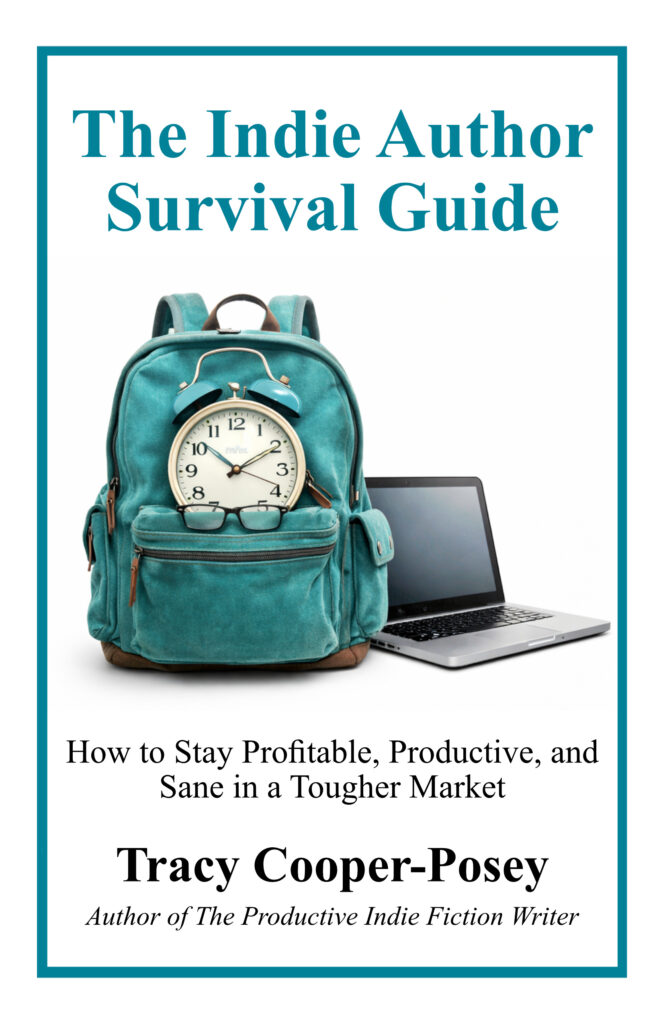
The Indie Author Survival Guide
How to Stay Profitable, Productive and Sane in a Tougher Market
Now Available.

The Productive Indie Fiction Writer: Strategies for Writing More, Earning More, and Living Well
Write More, Faster Than Ever Before | Are You Prolific?
Editing Your Next Novel? Mark Posey offers fast, writer-friendly edits with zero drama. Check out services »