This post is part of the Solar Sail Theory series.
- The Solar Sail Theory of Indie Publishing
- Email List Size Really Does Matter
- Should You Blog? A Solar Sail Theory Answer
- Being Seen: Why Visibility Matters More Than Virality
- Direct Sales and Removing Drag
- Why Fast(er) Writers Build Bigger Sails
- The Death of the Rocket Launch Career
- People Are Part of Your Sail
- Cultivating Luck
- The Magic of Increments
- How to Expand Your Discoverable Surface Area
One of the easiest ways to dismiss someone else’s success is to shrug and say, “They were lucky.” Publishing is full of stories like that.
An author goes viral on TikTok. A celebrity mentions a book. A retailer features a title. A podcaster recommends a novel to millions of listeners. A book club chooses an author’s novel. A reviewer with a huge following falls in love with another author’s latest release.
Luck.
But if you’ve spent enough time watching publishing careers, something becomes obvious. Some authors seem to get lucky far more often than others. If luck were truly random, that shouldn’t happen.
The truth is that luck isn’t as mysterious as we like to believe. It’s actually another source of momentum.
Luck and Your Solar Sail
One of the ideas behind Solar Sail Theory is that careers don’t depend on one giant burst of energy. They are built from countless tiny pushes, each one adding a little more speed.
Luck works exactly the same way. Every recommendation. Every review, interview, mention on social media and every bookseller hand-selling your novel. Every reader telling a friend. Every algorithm deciding to show your book to one more customer.
Each event is tiny. On its own, it probably won’t change your career.
Together, they can.
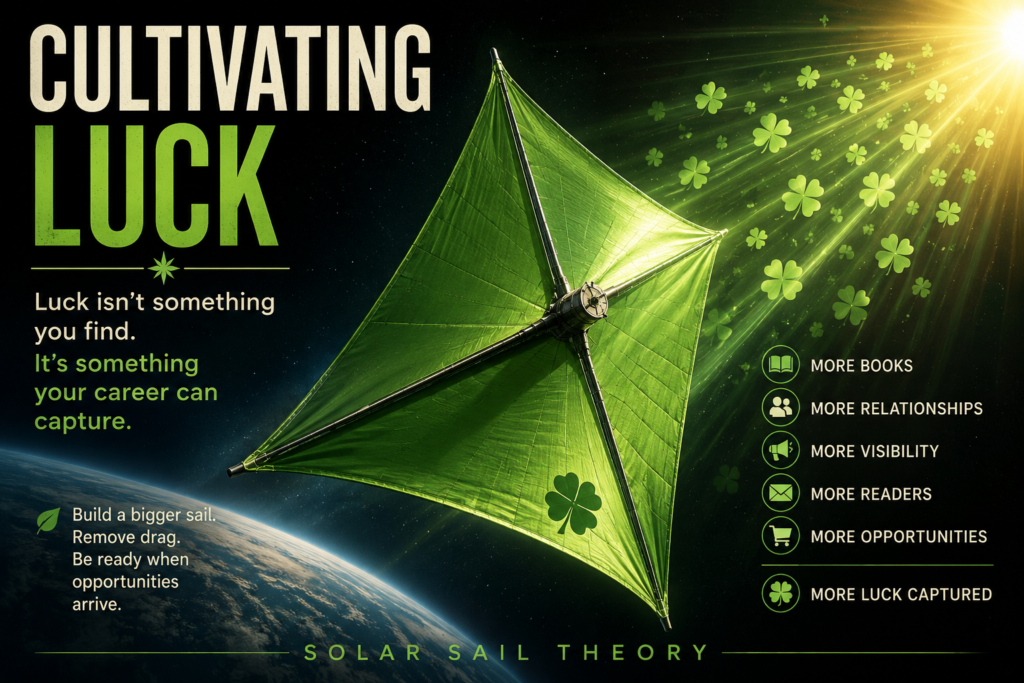
The problem is that most writers think of luck as something that happens to them. Instead, it’s more useful to think about luck as something your career can capture.
A solar sail doesn’t create sunlight. It doesn’t persuade the Sun to shine a little brighter today. It simply exposes as much sail as possible to the photons that are already there.
Your writing career works the same way. The more books you have available, the more chances readers have to discover you. The more retailers carry your work, the more places readers can find you. The more visible your website is, the easier you are to recommend. The more consistently you publish, the more often you appear on someone’s radar. The larger your mailing list, the more readers hear about your next release. The more relationships you build, the more industry people think of you when opportunities arise.
None of these things guarantees success. Each one simply increases the surface area of your sail. That means every unexpected opportunity has a greater chance of adding momentum instead of slipping past unnoticed.
Drag Repels Luck
This is also why removing drag matters.
Suppose a retailer unexpectedly promotes one of your books. Wonderful. Now what?
If you have one standalone title, no website, no newsletter, no series, and no way for readers to discover what else you’ve written, much of that momentum simply disappears.
If you have a series ready to read, a website that welcomes visitors, a mailing list, books available everywhere readers shop, and a direct sales store, the exact same lucky break can ripple through your entire business.
The opportunity was identical. Your ability to capture it wasn’t.
Luck Changes Your Mindset
There’s another aspect of luck that often goes unnoticed. A small piece of luck changes how you think.
A reader sends a wonderful email. A respected author recommends your work. A podcast host invites you onto their show. A local bookstore asks you to do a signing.
Those experiences make it easier to believe that opportunities exist.
That matters.
Not because the universe is listening. Because you are.
Because of that tiny touch of luck, you’re more likely to say yes to the next invitation. You’re more likely to pitch the next podcast. You’re more likely to approach the next bookseller. You’re more likely to try the next retailer.
You’re more willing to expose a little more sail.
Those actions create more opportunities. Some of those opportunities become more luck. That’s not manifestation. It’s behaviour.
The Myth of the Big Break
The biggest myth in publishing is the idea of the Big Break. It’s a wonderful story. An unknown writer is discovered. One lucky moment changes everything. The career is made.
Real publishing careers rarely work that way. The “big break” is usually just the first moment everyone else notices years of accumulated momentum.
By the time readers call someone an overnight success, that author has often spent years writing books, building a catalogue, learning marketing, growing a readership, and saying yes to opportunities that seemed insignificant at the time.
They weren’t waiting for luck. They were building a career that could make use of it.
You can’t control whether someone recommends your novel next week, or whether a retailer features your latest release. You can’t control whether your next interview reaches exactly the right reader.
But you can control the size of your sail.
You can write another book. You can improve your website, or build your mailing list or both. You can remove drag from your business. You can make it easier for readers to find everything you’ve written.
You can keep showing up.
The sunlight is going to fall somewhere. Your job isn’t to chase it. Your job is to be ready when it falls on you.
Now Available.

The Anti-Ensh*ttification Field Manual for Indie Authors:
Because the platforms will decay…but your career doesn’t have to go down with them.
Now Available.

The Indie Author Survival Guide
How to Stay Profitable, Productive and Sane in a Tougher Market
Now Available.

The Productive Indie Fiction Writer: Strategies for Writing More, Earning More, and Living Well
Write More, Faster Than Ever Before | Are You Prolific?
Editing Your Next Novel? Mark Posey offers fast, writer-friendly edits with zero drama. Check out services »