This post is part of the Solar Sail Theory series.
- The Solar Sail Theory of Indie Publishing
- Email List Size Really Does Matter
- Should You Blog? A Solar Sail Theory Answer
- Being Seen: Why Visibility Matters More Than Virality
- Direct Sales and Removing Drag
- Why Fast(er) Writers Build Bigger Sails
- The Death of the Rocket Launch Career
- People Are Part of Your Sail
- Cultivating Luck
- The Magic of Increments
- How to Expand Your Discoverable Surface Area
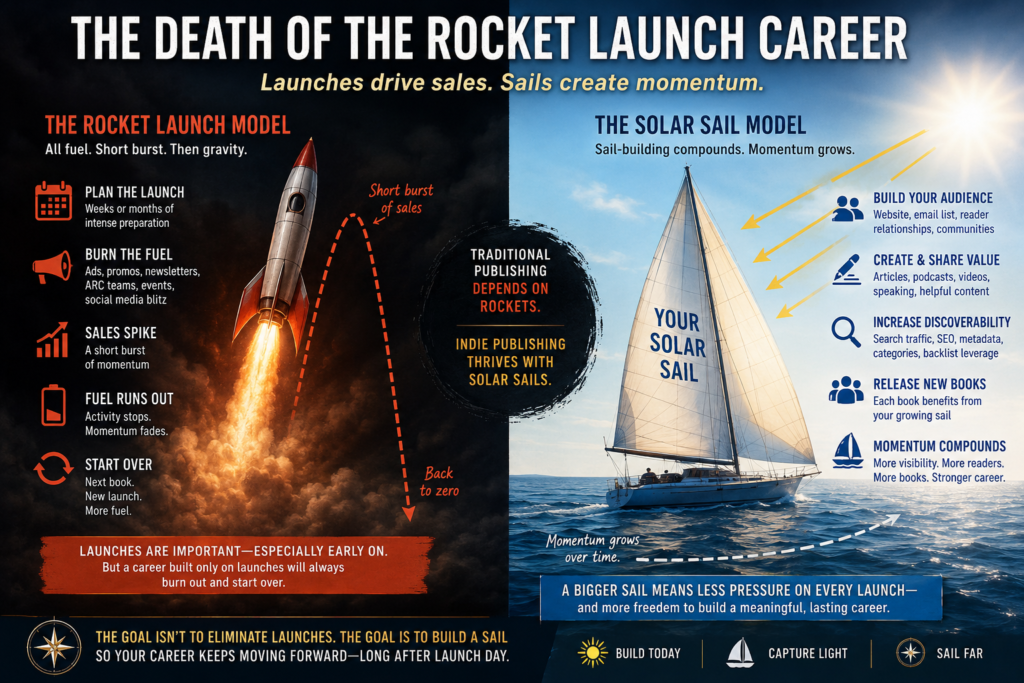
One of the most persistent ideas in publishing is that everything depends on launch day. Authors obsess over release schedules, launch teams, ARC campaigns, ad stacks, newsletter swaps, preorder counts, rankings, reviews, and sales numbers. Entire careers seem to rise or fall on what happens during a few frantic weeks surrounding publication.
It’s easy to understand why. For a long time, publishing really did work that way. But for indie authors, thishas changed. The rocket launch career is dying.
Book launches aren’t dead. Not even close. But a career built upon lurching from launch to launch is expiring. For indie authors, every new book does not have to carry your entire business on its back.
The Rocket Model
A rocket carries all its fuel internally. When the engines ignite, it accelerates dramatically. But every second of acceleration consumes fuel. Eventually, the fuel runs out and the rocket stops accelerating.
Book launches work much the same way. You spend time, money, attention, energy, newsletter goodwill, advertising budget, and emotional capital to generate a burst of visibility and sales.
The launch works because you’re burning fuel. When the launch activities stop, the acceleration usually stops, too.
This isn’t a criticism of launches. They’re useful. They can be exciting. They can generate significant sales. But they are temporary by nature.
A launch is an event. A career is a system. Unfortunately, many authors spend their entire careers jumping from rocket launch to rocket launch, trying to maintain altitude through sheer effort.
Jane Friedman’s Two Types of Promotion
Jane Friedman recently drew a distinction between book promotion and author promotion. She describes book promotion as activities tied directly to a release:
- Review outreach
- Media appearances
- Events
- Social media campaigns
- Giveaways
- ARC distribution
These are focused, strategic efforts designed to generate sales during a specific period of time. She then contrasts them with author promotion:
- Publishing articles and essays
- Podcast interviews
- Speaking appearances
- Maintaining an online presence
- Building relationships with readers
- Creating useful content year-round
Reading her article, I found myself nodding along. What she’s calling author promotion is remarkably close to what Solar Sail Theory calls sail-building.
One generates immediate thrust. The other increases your ability to capture energy over time.
Both matter. But they do very different jobs.
Why Traditional Publishing Still Depends on Rockets
This is where traditional publishing and indie publishing begin moving toward opposite ends of the spectrum. For traditional publishing, launches still matter enormously.
A publisher invests heavily in a book and concentrates much of its effort around publication. The sales team pitches the title. Publicists schedule interviews and appearances. Booksellers decide how many copies to stock. Retailers decide how much visibility the book receives.
Everyone’s attention is focused on a relatively small launch window. A strong launch can influence future contracts, future marketing support, bookstore placement, and retailer enthusiasm. A weak launch can have the opposite effect.
For traditionally published authors, launch performance often determines what opportunities come next. The system is built around ignition. The rocket model makes sense.
Why Indie Publishing Is Different
Indie publishing operates under different physics. There is no sales force. There is no seasonal catalogue. There is no limited publicity window after which the industry moves on to next month’s releases. Your book is not stocked in book stores with limited shelf life, who tear the cover off after 30 days and ship the book back for a refund (aren’t you glad of that?).
Your books remain available for as long as you leave it uploaded on retail store sites. Your books can continue finding readers indefinitely. That means that a disappointing launch is not necessarily a verdict. It’s simply one moment in the life of a book.
Many indie authors have experienced books that barely moved during release month and later became reliable sellers. Some books take months. Others take years. This has happened so many times with my books that I’m no longer surprised when one of my back catalog books suddenly starts selling hand over fist.
The indie advantage is time.
Solar Sail Theory only works because indie publishing gives books time to continue collecting sunlight.
Launches Drive Sales. Sails Create Momentum.
A launch can absolutely increase sales. It can generate reviews, alert existing readers and wake up retailer algorithms. It can put a book in front of people who might otherwise miss it. All good things.
But most launch activities have short lifespans. A release email is quickly forgotten, promotions end, and launch events come and go. The effect is real, but temporary.
Sail-building activities are different. A blog post may continue attracting readers for years. A podcast interview may introduce you to readers who follow your work indefinitely. An email subscriber may buy multiple books over many years. A direct-sales customer may become one of your most valuable readers.
Search traffic compounds. Visibility compounds. Reputation compounds. Relationships compound.
These things continue working long after the original effort has been completed.
That’s the difference between thrust and sail area.
The Bigger Your Sail, the Less Your Launch Matters
This is the point that many authors find difficult to believe.When your sail is small, every launch feels life-or-death. You need every sale, every ranking and every review. The emotional pressure is enormous because each launch carries a large percentage of your business.
As your sail grows, this changes. You already have readers waiting. Your website already receives traffic and your email list generates sales. Your backlist is already attracting new readers, and your direct store already has customers. Your previous efforts continue contributing energy to the system.
A launch still helps. A strong launch is still welcome. But a mediocre launch no longer threatens the entire year. A disappointing launch no longer feels like a career-ending event.
The pressure starts to disappear.
So Do You Still Need Launches?
Usually, yes. Especially earlier in your career. Launches create visibility. They generate sales. They teach marketing skills. They encourage readers to pay attention.
They’re first gear.
Use them. Learn them. Improve them. But understand what they are.
Launches generate thrust. They do not significantly increase your sail.
The mistake many indie authors make is spending all their time improving launches while neglecting the activities that expand visibility and audience over the long term.
It’s possible to become very good at launching books while never building a meaningful sail.
The Smart Indie Approach
The goal isn’t to eliminate launches. The goal is to become less dependent upon them. Launch the book. Send the newsletter. Run the promotion. Gather reviews. Celebrate the release.
Then get back to building the sail.
Ten years from now, the launch itself probably won’t matter very much. The audience you’ve built will. The relationships you’ve created and the visibility you’ve earned will.
Those are the assets that continue catching sunlight long after launch day is forgotten.
Book launches aren’t dead. But the rocket launch career is. And that’s good news for indie authors.
Now Available.

The Anti-Ensh*ttification Field Manual for Indie Authors:
Because the platforms will decay…but your career doesn’t have to go down with them.
Now Available.
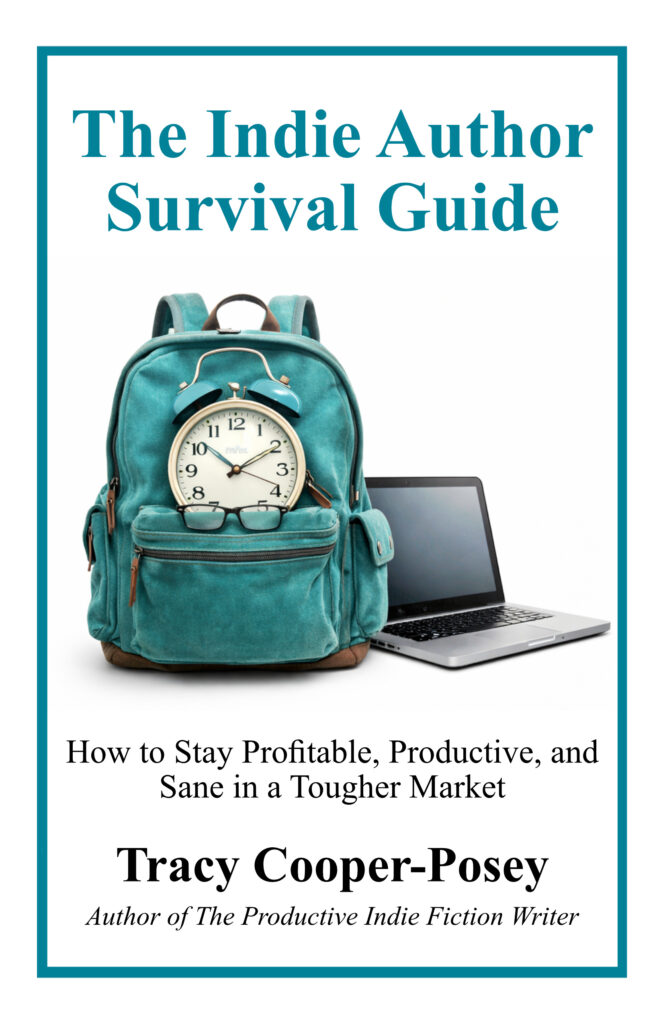
The Indie Author Survival Guide
How to Stay Profitable, Productive and Sane in a Tougher Market
Now Available.

The Productive Indie Fiction Writer: Strategies for Writing More, Earning More, and Living Well
Write More, Faster Than Ever Before | Are You Prolific?
Editing Your Next Novel? Mark Posey offers fast, writer-friendly edits with zero drama. Check out services »
Love this post! The Octopus email does look different; the formatting looks a little narrow and the font is smaller and harder to read :/ I didn’t notice it before the email for this post, though!
I do wonder about the wisdom of the rocket launch.. I keep wondering if traditional publishing companies should change their business model, too! Paper is expensive – I think the rising costs are just harder to avoid these days.
Thanks for the feedback about the newsletter, Bettina. I can certainly adjust the font.
I don’t know how the trad publishers could change their business model. They are centred upon print and distribution to bookstores. And readers are showing a new appreciation for print, now.
They’re certainly cutting costs where they can, though. Thinner and more fibrous paper. Although the cheaper mass market paperbacks have all but disappeared.
Cheers,
Tracy