This post is part of the Solar Sail Theory series.
- The Solar Sail Theory of Indie Publishing
- Email List Size Really Does Matter
- Should You Blog? A Solar Sail Theory Answer
- Being Seen: Why Visibility Matters More Than Virality
- Direct Sales and Removing Drag
- Why Fast(er) Writers Build Bigger Sails
- The Death of the Rocket Launch Career
- People Are Part of Your Sail
- Cultivating Luck
- The Magic of Increments
- How to Expand Your Discoverable Surface Area
There is a principle so powerful that it can transform an ordinary investment into a retirement fund, a single lily pad into a pond completely covered with leaves, and a handful of books into a writing career.
Most of us know about it. Very few of us truly understand it.
We call it “compounding,” but I think that’s too sterile a word. It sounds like something that belongs in a finance textbook. It doesn’t convey what it feels like to live through it.
I’ve come to think of it as The Magic Of Increments.
The strange thing about compounding is that we all learn the mathematics at school, yet almost none of us grasp what those numbers actually mean. We understand the theory intellectually, but we don’t get it, not in our bones. Our instincts remain stubbornly linear. We expect results to arrive in proportion to our effort.
Life doesn’t work that way.
Watching compounding happen
For years I’ve had money invested in a simple indexed investment fund. It’s done well, although not without some spectacular drops. During COVID, watching the balance plunge was enough to make anyone question their life choices.
Then it recovered. Then it grew some more. Eventually something extraordinary happened.
I reached the point where I could withdraw the maximum amount each year, and by the end of that same year the balance had quietly climbed higher than it had been before I made the withdrawal.
That’s the moment the mathematics stopped being mathematics. It became something I could feel.
The longer I left the money alone, the harder it worked on my behalf. Time wasn’t simply adding to the returns. Time was multiplying them.
You have to watch compounding unfold in real time before it really sinks in.
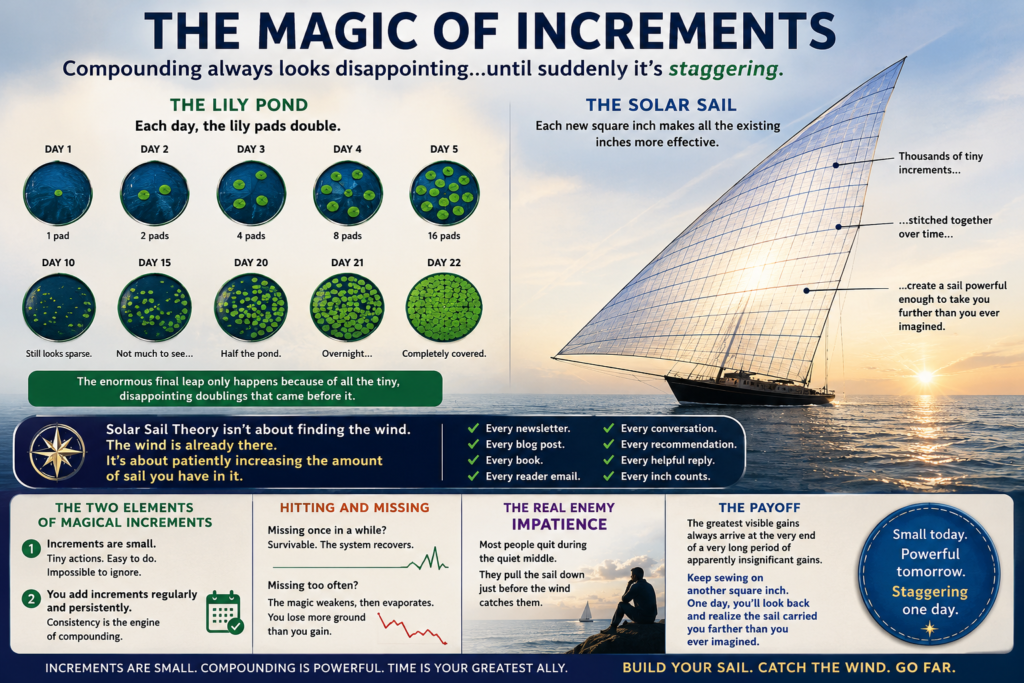
The lily pond
There’s another way to picture it. Imagine a pond with a single lily pad at one edge of the vast circle of water.
Every day the lily pads double their coverage. Day one: one lily pad. Day two: two. Day three: four.
At first, nothing seems to be happening. Even after weeks, the pond still looks almost empty. It’s like driving a cold car in first gear. The engine is working hard, making plenty of noise, but you don’t seem to be getting anywhere very quickly.
Then comes the astonishing part. On the day before the pond is completely covered, only half the surface is filled.
Half.
Overnight, the remaining half disappears beneath a sea of leaves.
The enormous final leap only happens because of all the tiny, disappointing doublings that came before it.
Compounding always looks disappointing…until suddenly it’s staggering.
The two elements of magical increments.
There are two elements that make the magic work.
- “Increments” are small.
- You add increments regularly and persistently.
That’s it. That’s the whole trick.
Increments
An increment is, by definition, small. 250 words a day. One podcast pitch per day. A friendly conversation every second day. A blog post every week. Two social media comments each afternoon. One conference a year.
Or, a ten minute walk after lunch. Twelve pushes up when you wake up, and increase the count by one each time.
Persistence
Each of those increments are small. But if you complete them every single day/week/month/year, the total effect is greater than the sum of the parts.
In other words, the compounding effect.
Hitting and missing
Missing a “thing” (task, routine, bullet journal habit, however you want to think of them) – missing one of them every now and then is survivable. My index fund “missed” big time during COVID, but it recovered. The lilly pond can have a few lillies die, but it will regroup and go on.
But if you fail to add to the increments too frequently, you completely lose the magic. It weakens, then it evaporates. Then you’re losing more ground than you’re gaining.
In the beginning, when you’re grinding through the low gears, it takes a degree of faith to keep going, to keep putting in the time.
Just think of that lily pond…and keep going.
The missing piece of Solar Sail Theory
As I’ve been writing this Solar Sail series, I’ve gradually realised that I wasn’t exploring separate ideas at all.
- Relationships.
- Trust.
- Visibility.
- Reputation.
- Luck.
- Opportunity.
They’re all expressions of the same underlying principle. They’re all examples of compounding.
Solar Sail Theory isn’t really about finding a better marketing tactic. It’s about patiently increasing the amount of sail you have in the wind. Every newsletter adds another square inch. Every blog post adds another square inch. Every book, every reader email, convention appearance, interview, and recommendation. Every helpful reply in a Facebook group. And on and on.
Individually, each one seems almost insignificant. That’s exactly why so many people abandon them.
One square inch is useless
Here’s the part I hadn’t fully appreciated until I started thinking about actual solar sails.
One square inch of sail is useless. Not weak. But actually useless. A single square inch cannot propel a spacecraft. Neither can two. Or twenty.
This is why missing too many increments and failing to harness the compounding effect is like poking big holes in your sail. You lose momentum…and eventually, you stop dead in space.
Danger, Will Robinson!
When this happens, you’re facing starting from scratch. Building your sail all over again.
A solar sail works when every square inch is joined to every other square inch, creating a single surface capable of catching the constant pressure of sunlight.
That’s what so many discussions about author marketing miss. People evaluate one newsletter. One podcast interview. One Facebook post, convention, Kickstarter, blog article.
Each one, considered in isolation, appears to achieve very little. They’re judging one square inch as though it were supposed to be an entire sail. It never was.
The power isn’t in the individual square inches. The power is in connecting them.
- Your newsletter makes your blog more valuable.
- Your blog helps readers discover your books.
- Your books give readers a reason to subscribe.
- Subscribers recommend your work.
- Recommendations improve discoverability.
- Discoverability attracts more readers.
Every new square inch makes every existing square inch a little more effective because they’re all part of the same sail. That’s the difference between building a system and chasing isolated tactics.
It’s not the business model
Indie authors love debating business models. Wide or exclusive? Direct sales or retailers? Kickstarter or Patreon? Advertising or organic growth? Podcasting? YouTube? Substack?
The conversation usually assumes the business model itself is the secret. I don’t think it is. Almost any well-founded business model can work if you stick with it long enough for the magic of increments to take hold.
That doesn’t mean every idea deserves endless persistence. Bad ideas don’t magically become good ones through repetition. A sail still needs sunlight. Compounding doesn’t rescue nonsense.
But if your strategy genuinely creates value for readers, builds relationships, strengthens trust, and gives people reasons to discover and remember you, then time becomes one of your greatest allies.
That’s true whether your sail is built from newsletters, direct sales, podcasts, convention appearances, or something else entirely.
The real enemy
We like stories about overnight success because they’re exciting. They’re also usually fiction. Look closely at almost any “overnight success” and you’ll find years of invisible work underneath.
Years of experiments. Years of mistakes, of tiny improvements. Years of adding another square inch to the sail.
The real enemy of compounding isn’t failure.
It’s impatience.
Most author businesses don’t fail because the underlying idea was wrong. They fail because the owner switched to another idea before the first one had time to compound.
Solar Sail Theory has never been about shortcuts.
It’s about understanding that worthwhile things grow differently from the way our instincts tell us they should. Not in straight lines. Not at a constant pace. But through the quiet, almost invisible accumulation of countless small increments that eventually become something astonishing.
Keep sewing on another square inch.
One day you’ll look back and realise the sail has become large enough to carry you farther than you ever imagined.
Now Available.

The Anti-Ensh*ttification Field Manual for Indie Authors:
Because the platforms will decay…but your career doesn’t have to go down with them.
Now Available.
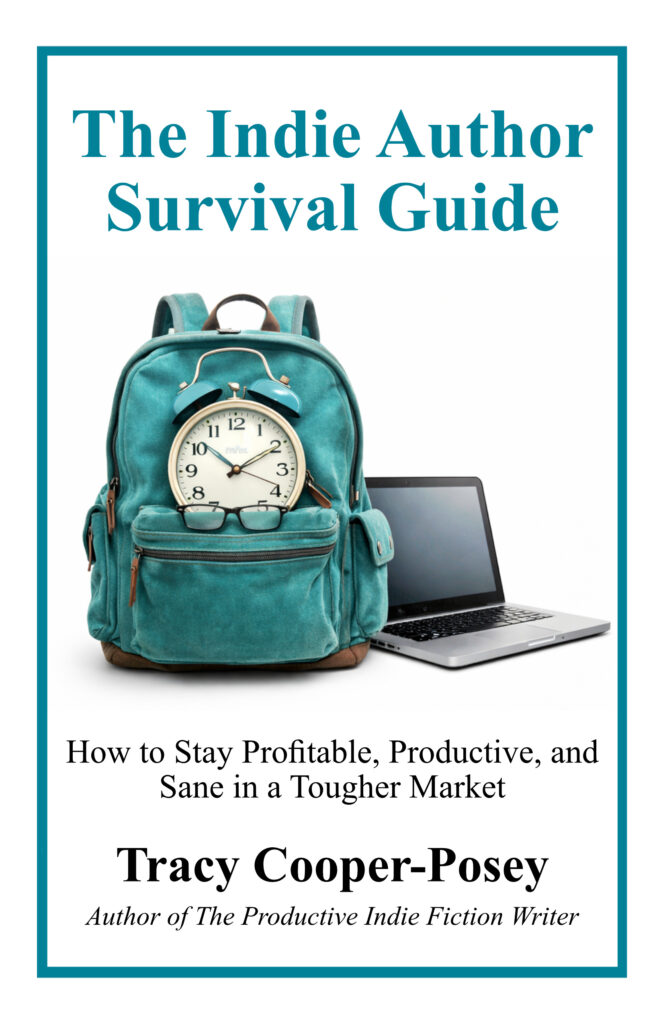
The Indie Author Survival Guide
How to Stay Profitable, Productive and Sane in a Tougher Market
Now Available.

The Productive Indie Fiction Writer: Strategies for Writing More, Earning More, and Living Well
Write More, Faster Than Ever Before | Are You Prolific?
Editing Your Next Novel? Mark Posey offers fast, writer-friendly edits with zero drama. Check out services »