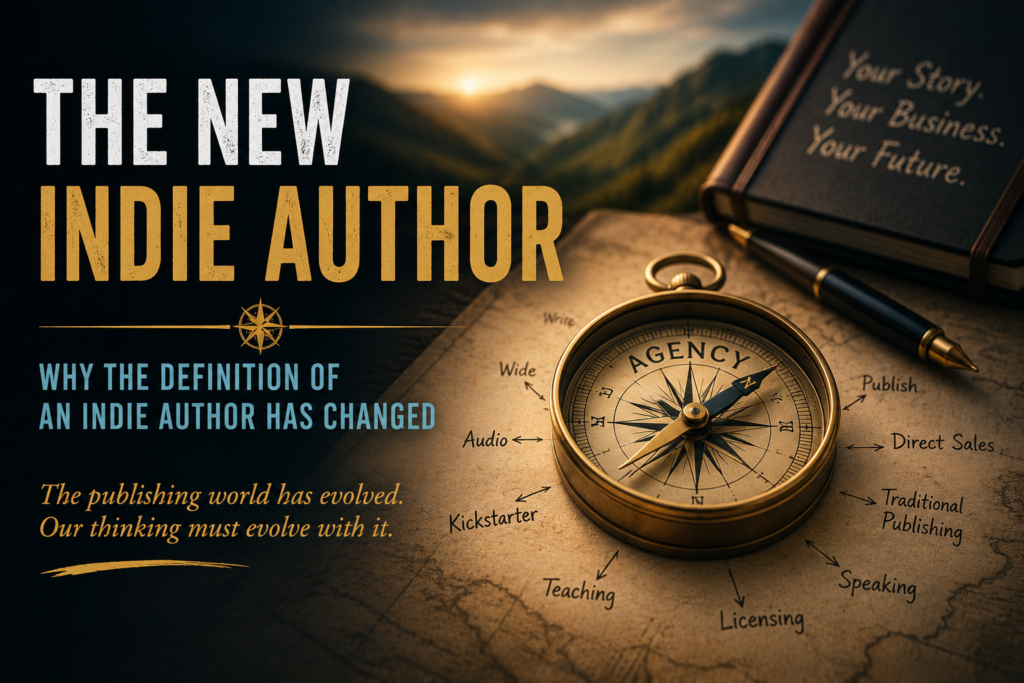
The New Indie Author
Why the definition of an indie author has changed
Fifteen years ago, I knew exactly what an indie author was.
An indie author wrote books—usually fiction—published them independently, built a catalogue, found readers, and made a living from the work. The entire business revolved around writing more books and reaching more readers. It was a wonderfully straightforward model, and for many of us, it worked.
It certainly worked for me. I became an indie author in 2011, just four years after the first Kindle appeared. Those were the formative years of modern independent publishing. We weren’t following a well-worn path. We were helping to create one.
Back then, “indie” meant something very specific. We controlled our rights. We published our own work. We built our own businesses instead of asking for permission to enter someone else’s.
And perhaps most importantly, we proved that it could be done.
Looking back, I don’t think we appreciated how radical that was. We weren’t simply choosing a different way to publish. We were creating an entirely new publishing ecosystem alongside the traditional one.
For that reason, the original indie movement needed certainty. It needed confidence and clear borders.
We drew a line between traditional publishing and independent publishing because, at the time, those distinctions mattered. Every new movement needs an identity. Every revolution needs a flag.
So we embraced a kind of binary thinking.
- Traditional or indie.
- Gatekeepers or independence.
- Permission or ownership.
Those weren’t simplistic slogans. They were the foundations of a movement that changed publishing forever. And they worked.
The modern indie publishing industry exists because thousands of authors believed those ideas strongly enough to build businesses around them.
I still believe in those ideas.
But I don’t believe the definition of an indie author has kept pace with the publishing industry.
While our philosophy has remained remarkably consistent, the world around it has changed. Not suddenly, but gradually. Almost imperceptibly. Until one day, many of the assumptions that served us so well in 2011 no longer described the industry we were working in.
And that’s where I think The New Indie Author begins.
The Playing Field Tilted
No industry stands still. Publishing certainly hasn’t.
Some of the biggest changes have been technological. Others have been economic. Some are simply the result of success. Independent publishing became so successful that millions of new books entered the marketplace. More authors, more publishers, more readers, more platforms, more opportunities.
That’s something worth celebrating. But every success carries consequences.
A reader who once had a choice between a few thousand indie books now has millions. Discoverability has become dramatically harder. Advertising that once produced reliable returns has become less predictable and far more expensive. Retail platforms have become larger, more sophisticated—and, in many cases, less transparent about how books are surfaced and sold.
Behind an increasingly opaque curtain, algorithms and the constant changes to them influence who discovers our books, how visible they become, and ultimately how well they sell. We don’t know exactly how those decisions are made, only that they have become an increasingly significant part of doing business as an author.
At the same time, the wider economy has changed. Inflation has reduced discretionary spending. Publishers have pushed ebook prices steadily higher while many independent authors remain anchored to pricing assumptions formed more than a decade ago. Readers have become accustomed to subscription services, permanent discounts, and free books as a normal part of the publishing landscape.
Then there are entirely new pressures that simply didn’t exist when many of us started.
Large-scale piracy has become almost industrialized.
AI-generated “slop”—books produced from a single prompt, given a generic cover and uploaded in bulk—adds noise to already crowded marketplaces. These books aren’t competing on quality; they’re competing for attention. And attention has become one of the scarcest resources in publishing.
None of these developments, on their own, destroyed independent publishing.
Together, however, they’ve fundamentally changed the landscape we work in.
Technology writer Cory Doctorow coined the term enshittification to describe the predictable lifecycle of digital platforms. They begin by serving users. Then they shift toward serving business customers. Eventually, as they mature, they optimize primarily for themselves and their shareholders. It isn’t usually malicious. It’s simply what mature businesses do.
Publishing platforms aren’t immune to that pattern. Fifteen years ago, independent authors and the major ebook retailers were remarkably well aligned. The platforms needed books. We needed readers. Our success became their success.
Today, those same platforms serve many constituencies: readers, subscription programs, major publishers, advertisers, AI initiatives, investors and shareholders. Sometimes their priorities align with ours. Sometimes they don’t.
That isn’t a criticism. It’s reality.
As independent authors, we can no longer safely assume that the platforms we rely upon will always have incentives that closely match our own. Their first responsibility is to their businesses. Ours must be to ours.
The Negative Tilt
I think of it as a negative tilt in the original indie playing field.
The game itself hasn’t changed. We still write books. We still publish them. We still connect with readers. But the field is no longer level.
These days, we often have to sprint simply to stay where we are. Getting ahead requires sustained effort that can be difficult to maintain over the long term.
Fifteen years ago, you could publish a book, earn sales with relatively little promotion, and get on with writing the next one. Today, that kind of coasting often means you’ll begin sliding backwards down the hill.
If you’ve ever slipped down a grassy slope or launched yourself down a waterslide, you know what happens. The farther you slide, the faster you go. Climbing back to where you started takes far more effort than simply staying there in the first place.
That’s the position many established indie authors find themselves in today. Not because we did anything wrong. But because we’re trying to play the 2026 game using 2011 strategies.
Some of the assumptions that worked beautifully in 2011 don’t work as reliably today. Others still work—but only in certain circumstances. Tactics that were once almost universally recommended have become contextual. What works brilliantly for one author may fail completely for another.
That’s an important distinction. The problem isn’t independent publishing. The problem is assuming that yesterday’s best practices are today’s “universal truths”.
For a long time, indie publishing was built around a series of either/or choices.
- Wide or exclusive.
- Traditional or independent.
- Advertising or organic growth.
- Premium pricing or bargain pricing.
Every debate seemed to demand that one side be declared the winner.
That binary thinking was necessary while we were building the modern indie movement. I don’t think it serves us anymore.
The publishing ecosystem has become too large, too varied, too interconnected and too complex for binary answers. The question is no longer, “Which side are you on?” The question is, “What are you trying to build?”
Instead of defending the old playing field, I think we need to expand it. Not by abandoning what made independent publishing successful, but by broadening our understanding of what it means to be an independent author.
Because independence isn’t about how we publish.
It’s about retaining the freedom to choose the strategy that best serves the business—and the life—we’re trying to build.
The New Indie
If the playing field has changed, then the obvious question is:
What does it mean to be an indie author now?
For a long time, the answer seemed straightforward. An indie author published independently.
That definition served us well while we were building the baby industry. It distinguished us from traditional publishing and reminded us that we no longer needed permission to build successful writing careers.
Today, I don’t think that’s enough. Publishing independently is still a tactic. Independence, though, is something much larger.
To me, The New Indie Author is someone who intentionally builds an independent creative business around their own definition of success, using every legitimate strategy available while preserving creative freedom and independence.
Notice what isn’t in that definition. It doesn’t mention Amazon. Or Kickstarter. Or direct sales, traditional publishing, wide distribution, subscriptions, AI or advertising.
Those aren’t philosophies. They’re tactics.
The New Indie isn’t defined by the tools they use. They’re defined by why they choose them.
Mission Comes First
One of the assumptions hidden inside the original indie movement was that we all wanted roughly the same thing. Write books. Sell books. Quit the day job. Write more books.
For many of us, that was exactly the right goal. Today, I don’t think we can make that assumption. Every independent author is trying to build a different life.
- Some want the biggest possible income.
- Some dream of bestseller lists.
- Others want awards.
- Some want film and television deals.
- Some want to teach.
- Some want to become public speakers.
- Some simply want the freedom to write one novel a year while holding another career.
The variety of end-goals is as numerous as indie authors themselves. And no one’s goals are wrong. They’re simply different.
My own mission has become surprisingly simple. I want a sustainable creative life that allows me to write the stories I want to write, when I want to write them, while earning enough income to support that life.
That mission won’t be everyone’s. Nor should it be.
And if you, like me, tend to recoil at the corporation speak of “mission”, then think of it simply as your end-goal, what you want out of this crazy publishing business we’re in.
The important thing isn’t that we all share the same destination. It’s that we know what our own destination actually is. Once you know where you’re trying to go, decisions become much easier.
Independence Is A Philosophy
This, I think, is the biggest change for the New Indie Author. For years, we often treated independence as though it were a publishing model. I don’t think it is.
Independence is a mindset. It’s a philosophy.
It’s the belief that the author—not a retailer, not a publisher, not a platform, not an algorithm—should remain the primary decision-maker in the direction of their own business.
That doesn’t mean doing everything yourself. It doesn’t mean rejecting partnerships and it doesn’t mean avoiding traditional publishing.
Quite the opposite. A truly independent author should be free to consider every legitimate opportunity and fit it up against their own goals and priorities.
- Traditional publishing.
- Direct sales.
- Wide distribution.
- Kindle Unlimited.
- Licensing.
- Translation rights.
- Crowdfunding.
- Speaking.
- Teaching.
- Consulting.
- Or something that hasn’t even been invented yet.
None of these choices determine whether you’re an indie author. The question isn’t: “Is this indie enough?” The question is: “Does this move me closer to the business—and the life—I’m trying to build while preserving my freedom to choose again tomorrow?”
That’s a very different question. It’s also a much more useful one.
The New Indie, above all else, strives to maintain their agency.
The publishing industry won’t stop changing. There will always be new platforms, new technologies, new opportunities and new disruptions. The New Indie doesn’t try to predict which tactic will win next.
The New Indie builds a philosophy flexible enough to survive whatever comes next.
How The New Indie Makes Decisions
A philosophy, on its own, isn’t enough. It’s easy to say that independence matters. It’s much harder to decide what to do when opportunities appear.
Should you sign a traditional publishing contract?
- Launch a Kickstarter?
- Join Kindle Unlimited?
- Spend six hours a week making TikTok videos?
- Take on freelance editing?
- Raise your prices?
- Lower them?
- Start a Patreon?
- Write to market?
- Experiment with AI?
There are no universal answers to those questions. And that’s exactly why I believe the next generation of indie publishing needs something more durable than another list of best practices.
It needs a way to think.
Solar Sail Theory
For me, that framework is Solar Sail Theory.
The central idea is simple. Every decision should move the business toward its long-term destination.
Not every opportunity deserves to be accepted. Not every profitable idea is worth pursuing. Not every distraction is harmless. Every hour spent on one activity is an hour that can’t be spent on another. Every new commitment closes off other possibilities.
Solar Sail Theory asks questions like these:
- Does this move me toward my mission?
- Does it strengthen my business five or ten years from now?
- What opportunities am I giving up if I say yes?
- Am I steering deliberately, or simply reacting to whatever is happening around me?
Those questions rarely produce easy answers. But they usually produce better ones.
Anti-Enshittification
If Solar Sail Theory helps decide where to steer, Anti-Enshittification is the safety harness.
It recognizes that today’s publishing ecosystem will continue to evolve in ways that make sense for the platforms, retailers and companies that operate within it.
That isn’t something to resent. It’s something to prepare for. Anti-Enshittification asks a different set of questions.
- Am I becoming dependent on a single platform?
- Am I creating unnecessary fragility?
- Am I preserving my ability to adapt?
- Am I increasing—or reducing—my agency?
Sometimes the answer will still be to commit wholeheartedly to a particular platform or strategy. That’s fine. The point isn’t to avoid commitment.
The point is to make that commitment consciously, understanding both its benefits and its risks.
Together
Solar Sail Theory and Anti-Enshittification don’t tell me what decisions to make. They help me make better decisions. They don’t produce identical answers for every author because every author begins with a different definition of success.
An author whose goal is maximum income over the next three years may make very different choices from someone who wants to build a business that supports thirty years of writing. Neither author is wrong. They’re simply sailing toward different destinations.
The important thing is that both are making deliberate choices instead of following industry dogma.
The publishing industry will continue to change. Our missions may change. Our tactics certainly will. Our philosophy shouldn’t have to.
Everything Must Earn Its Place
One of the hidden risks of a long indie career is accumulation: As you develop your catalogue, you also acquire launch strategies, newsletter practices, advertising processes, social media hacks, workflows, marketing tactics and checklists. You building software, business practices and policies.
Over the years, they pile up. Some continue to earn their keep. Others quietly become habits. A surprising number simply become “the way we’ve always done it.”
One of the principles of The New Indie is that nothing gets a free pass. Not old ideas, nor new ones.
Everything has to earn its place.
Recently, Mark and I started pulling apart every aspect of our publishing business. Not because anything is wrong. Quite the opposite. Our business works.
But the publishing environment has changed, and we wanted to know whether every practice we had accumulated over fifteen years still deserved the time, money and attention we were giving it. Everything.
Some things survived the examination immediately. Others didn’t. Some needed to be modified. Some needed to be let go.
And some were things, tasks, chores, and work processes we hadn’t questioned in years simply because they’d become routine.
I think this is one of the hardest things for experienced indie authors to do. New authors don’t have fifteen years of accumulated practices to sort through. Veterans do.
We’ve all built systems that made perfect sense when we created them. One of the most useful questions I’ve found is also one of the most uncomfortable.
If I weren’t already doing this, would I choose to start doing it today?
Knowing everything I now know about publishing, my business, my priorities and my mission…would I deliberately add this to my workload? If the answer is no, then the obvious follow-up question is: Why am I still doing it?
Everything Is A Choice
This way of thinking has changed how I look at opportunities. Traditional publishing contracts, direct-sales initiatives, speaking engagements, consulting offers, new social media platforms, a software subscription, marketing campaigns.
None of these are automatically good. None of them are automatically bad. They’re simply opportunities. Each one has to justify the time, energy and attention it asks of me.
And each must let me maintain my independence and agency.
Take a hypothetical example. Suppose someone offered me a full-time editing position paying $60,000 a year. Fifteen years ago, I might have evaluated that offer almost entirely by the salary.
Today, I wouldn’t. I’d put it through the same framework I use for every important decision. Does it move me toward the life I’m trying to build? Does it strengthen my business in the long term?
What opportunities disappear if I accept it? What happens to my writing? What happens to my agency? What happens if that employer restructures in three years?
Those questions matter more than the headline salary. And someone else might answer them differently. That’s perfectly reasonable. If their mission is different, their conclusion will be different, too. And that’s the point.
The New Indie doesn’t tell authors what decisions to make. It encourages them to make those decisions consciously, because every hour we spend is invested in one future instead of another.
And I think that’s the real shift. The original indie movement taught us how to publish independently. The New Indie asks us to build our businesses just as deliberately.
The Future Is Still Independent
When independent publishing began, we were trying to prove something:
- That authors didn’t need permission to build careers.
- That readers would happily buy books outside the traditional system.
- That quality wasn’t determined by the logo on a spine.
- That authors could become entrepreneurs without sacrificing their creativity.
Against considerable skepticism, we proved all of those things. The independent publishing movement didn’t merely survive. It transformed publishing. That success is worth celebrating.
But success has a curious habit of changing the very conditions that created it. The industry we built in 2011 no longer exists. It has grown larger, more complex and more interconnected than any of us could have imagined.
Our thinking must change to meet it.
I don’t believe that means abandoning the principles that built the indie movement. Quite the opposite. I think it means returning to the principle that mattered most.
Agency.
Not independence for its own sake. Not publishing independently as an identity. But preserving our ability to choose. To decide what success looks like, and which opportunities to accept. To decide which ones to decline.
To build businesses that serve our lives instead of lives that serve our businesses.
That’s what independence has always meant. Not isolation or ideology. Just simply choice.
The publishing industry will continue to change. The tactics we use ten years from now will almost certainly be different from the tactics we use today.
I hope they are. Because that will mean we’re still learning, adapting and steering our own course.
The New Indie Author isn’t a rejection of the past. It’s the next chapter of the same story. One that began with authors discovering they didn’t need permission, and continues with authors discovering they don’t need anyone else to define what success—or independence—looks like.
Now Available.

The Anti-Ensh*ttification Field Manual for Indie Authors:
Because the platforms will decay…but your career doesn’t have to go down with them.
Now Available.
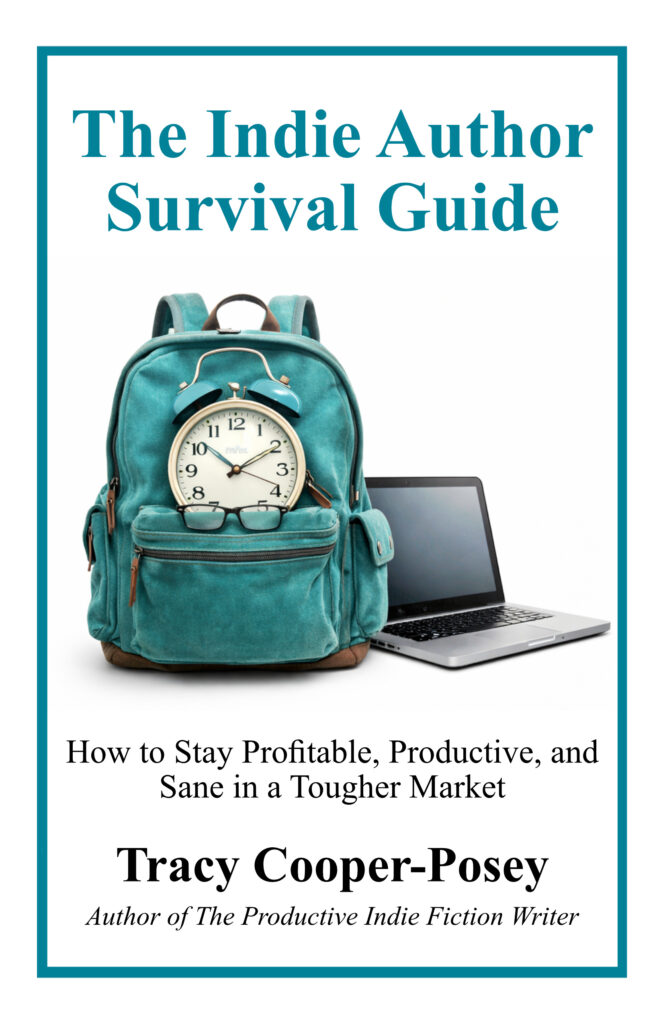
The Indie Author Survival Guide
How to Stay Profitable, Productive and Sane in a Tougher Market
Now Available.

The Productive Indie Fiction Writer: Strategies for Writing More, Earning More, and Living Well
Write More, Faster Than Ever Before | Are You Prolific?
Editing Your Next Novel? Mark Posey offers fast, writer-friendly edits with zero drama. Check out services »
My author goal is now similar to yours. I am trying to build my author business that supports that life. I am finding different ways to keep visible and discovered that work for me and sell books at the same time.
That’s a great strategy: Find what works, and iterate.
Although, things can change, so you also need to be monitoring and researching new strategies as well.
the work goes on.
But there’s nothing better than working from home, writing fiction and being paid for it. 🙂
Tracy