This post is part of the Solar Sail Theory series.
- The Solar Sail Theory of Indie Publishing
- Email List Size Really Does Matter
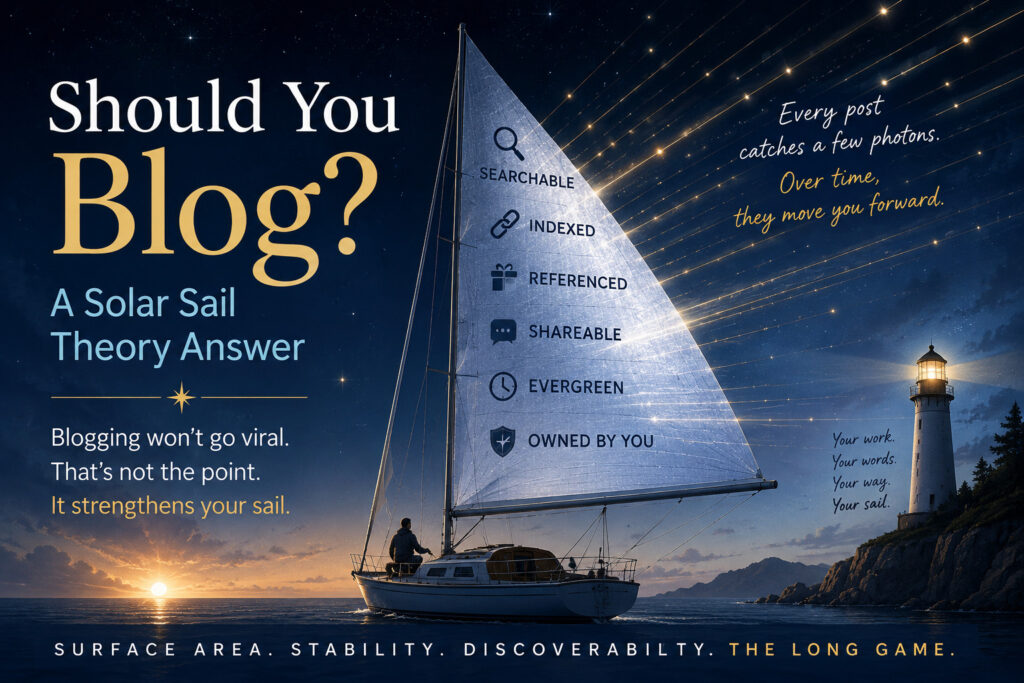
- Should You Blog? A Solar Sail Theory Answer
- Being Seen: Why Visibility Matters More Than Virality
- Direct Sales and Removing Drag
- Why Fast(er) Writers Build Bigger Sails
- The Death of the Rocket Launch Career
- People Are Part of Your Sail
- Cultivating Luck
- The Magic of Increments
- How to Expand Your Discoverable Surface Area
Every few years, someone declares that blogging is dead. Usually loudly. Usually confidently. Usually while selling a course about the thing you’re supposed to do instead.
And to be fair, a certain version of blogging is dead. The old blogging ecosystem—the one from the mid-2000s—is mostly gone. The sprawling blogrolls. The comment communities. The endless reciprocal linking. The “tag, you’re it” posting chains. The sense that the internet was made up of interconnected little digital villages instead of giant algorithmic shopping malls.
That world faded. Social media swallowed most of it whole. When indie publishing gurus say “blogging doesn’t work anymore,” they’re often arguing against a version of blogging that no longer exists.
But the Solar Sail Theory forces us to ask a different question. Not: “Is blogging alive?” But: “Does blogging strengthen your sail?” That’s the useful question. The practical question that helps you evaluate strategies without fear, panic, or guru worship.
One of the reasons I wanted to develop the Solar Sail Theory in the first place was to create a framework for filtering the endless flood of contradictory advice authors receive:
- You must be on TikTok.
- Email is dead.
- Facebook is dead.
- Ads are mandatory.
- Ads are a scam.
- Rapid release or perish.
- Slow writing is the only genuine writing.
- Wide publishing is pointless.
- Amazon is evil.
- You must write to market.
- You must build a personal brand.
Spend enough time in indie publishing circles and eventually it starts sounding like a room full of cult leaders fighting over the last doughnut. Solar Sail Theory gives you a calmer way to think about all of it:
- Does this thing expand your discoverability surface area?
- Does it help readers encounter you?
- Does it create durable infrastructure?
- Does it reduce fragility?
- Does it strengthen assets you control?
If yes, then maybe it’s worth testing.
Blogging, despite all the declarations of its death, still passes that test remarkably well. Blogging provides two things social media cannot truly offer: Permanence and searchability.
A social media post vanishes almost instantly. Even successful posts are usually swallowed by the timeline within hours or days. Platforms are designed around velocity, novelty, and constant replacement.
A blog post, meanwhile, can continue attracting readers for years. It can be indexed by search engines, linked to by other sites, referenced in newsletters, found accidentally by someone searching a specific question at two in the morning while procrastinating sleep.
And increasingly, blogs are more accessible to AI-driven search systems than closed social platforms. An Instagram caption is largely trapped inside Instagram’s ecosystem. A publicly accessible blog post, meanwhile, can be indexed, parsed, summarized, referenced, and surfaced by search engines and AI assistants alike.
In an era where discovery is increasingly shifting toward AI-mediated search, openly accessible long-form content may become even more valuable.
That matters.
And don’t forget that a static author website is less appealing to search engines (and AI searchers) than a site that shows signs of life: updated pages, no cobwebs…a pulse. Blogging is that pulse.
A blog post is not just content. It’s infrastructure. And infrastructure behaves differently from social media activity. Social media is transient attention. Blogging is accumulated surface area. That distinction matters enormously.
Blogging is not a spike strategy.
This is where many authors become disappointed. They write three blog posts, stare at their analytics for forty-eight hours, and conclude that blogging is useless because it didn’t immediately sell books.
That’s like planting an orchard and becoming furious that apples did not appear by Thursday. Blogging is not designed to create explosive bursts of visibility. Occasionally that happens, but it’s not the core function.
Its real purpose is accumulation.
Attention online does not move in straight lines anymore. It drifts. It ricochets. It follows strange pathways through search engines, recommendation systems, shared links, citations, newsletters, forums, and algorithmic side currents.
Every post you publish creates another opportunity for discovery.
- Another indexed page.
- Another searchable phrase.
- Another entry point.
- Another tiny photon striking the sail.
Most of those photons are small. Tiny, even. One click here. One visitor there. A random reader who discovers an article, clicks another link, browses your fiction, signs up for your email list, and quietly disappears into your ecosystem until six months later when they buy something.
Individually, these interactions look unimpressive. Compounded over years?
Different story. That’s the part many “blogging is dead” conversations miss entirely. They focus only on immediate measurable return. Immediate sales. Immediate traffic. Immediate conversion. But compounding systems rarely look impressive at the beginning.
That’s true of investing. It’s true of publishing. And it’s true of blogging. One blog post will not change your career. Hundreds of blog posts across multiple years absolutely can.
I see this constantly across my own sites. I write under multiple pen names. Each has its own website. Each site has its own search footprint. I run this site, The Productive Indie Fiction Writer. Many posts are mirrored strategically at Stories Rule Press. None of this is accidental.
Every indexed page is additional real estate attached to my name and my work. Every essay creates another searchable pathway into my ecosystem. Not dramatically or virally, but steadily.
And this leads to a point that often gets overlooked in discussions about blogging:
Yes. Blogs can absolutely sell books.
Not usually in the blunt, direct-response-advertising sense people expect. Blogging is rarely a “Buy my novel now!” mechanism that generates instant spikes. But blogs create familiarity, trust, and authority. It builds curiosity and fosters connection.
A reader arrives because they searched for something. They stay because your site has depth. They browse because they become interested in you. They join your email list because they want more. And they buy later because the relationship already exists.
The sale may not be directly attributable to one specific post. This drives some marketers slightly insane because they desperately want perfectly trackable funnels and clean attribution models.
Human beings are messier than dashboards. Sometimes readers need repeated contact over long periods before they buy. Blogging supports that process extraordinarily well.
And unlike social media, blogging happens on territory you control.
That ownership matters more now than it did ten years ago.
Which brings us neatly to Substack.
Whenever blogging gets discussed these days, someone inevitably says, “Why not just use Substack?” And honestly, I understand the appeal. Substack has recreated something the old blogging ecosystem used to provide; community and referral networks. Recommendations. Cross-promotion. Discovery loops. A sense that writers are connected to each other again.
That’s valuable. But it also comes with a caveat: You are still building on borrowed land. Now, maybe that tradeoff is worth it to you. Maybe the discoverability and network effects outweigh the risks. Maybe it’s functioning as a useful extension of your overall sail.
But Solar Sail Theory encourages making those decisions consciously. If your Substack primarily drives readers toward assets you own—your website, your store, your email list—then yes, perhaps it meaningfully expands your surface area. If your entire ecosystem exists inside Substack? That’s a different level of dependency risk.
Convenience and ownership are not the same thing.
Personally, when I talk about blogging, I’m primarily talking about independently hosted sites. Usually WordPress. (And astonishingly, yes, Blogger/Blogspot still exists. Like a particularly stubborn raccoon.) Because ownership matters. Control matters. Durability matters.
Blogging Does Take Time and Effort
Now, none of this means blogging is free. Blogging takes time, and consistency. It requires ideas, maintenance and energy. And if you aren’t careful, blogging can become sophisticated procrastination disguised as productivity.
That danger is very real. A blog cannot substitute for fiction output. Infrastructure without product is decoration. If your catalog is thin, unfinished, or inconsistent, blogging will not magically compensate for that. Readers still ultimately need books to buy.
But if you do have books? If you are building for the long term? If you care about discoverability beyond retail algorithms? If you want assets you control? Then blogging remains one of the most durable tools available to indie authors.
Blogging isn’t glamorous, explosive or even trendy, anymore. But it is durable. And durability is the point. The longer I work in this industry, the more convinced I become that most sustainable author careers are not built through spikes. They are built through accumulation. A thousand small layers, and discoverability vectors. Thousands of tiny photons striking the sail over time.
Blogging is one of the simplest ways to increase your surface area. Combined with the other ways of expanding your solar sail that we’ll explore throughout this series, it adds up to a serious amount of energy driving your career-ship.
Blogging is not instant or dramatic, but it is steady. In a publishing landscape obsessed with velocity, steady may be one of the most underrated advantages left.
Now Available.

The Anti-Ensh*ttification Field Manual for Indie Authors:
Because the platforms will decay…but your career doesn’t have to go down with them.
Now Available.
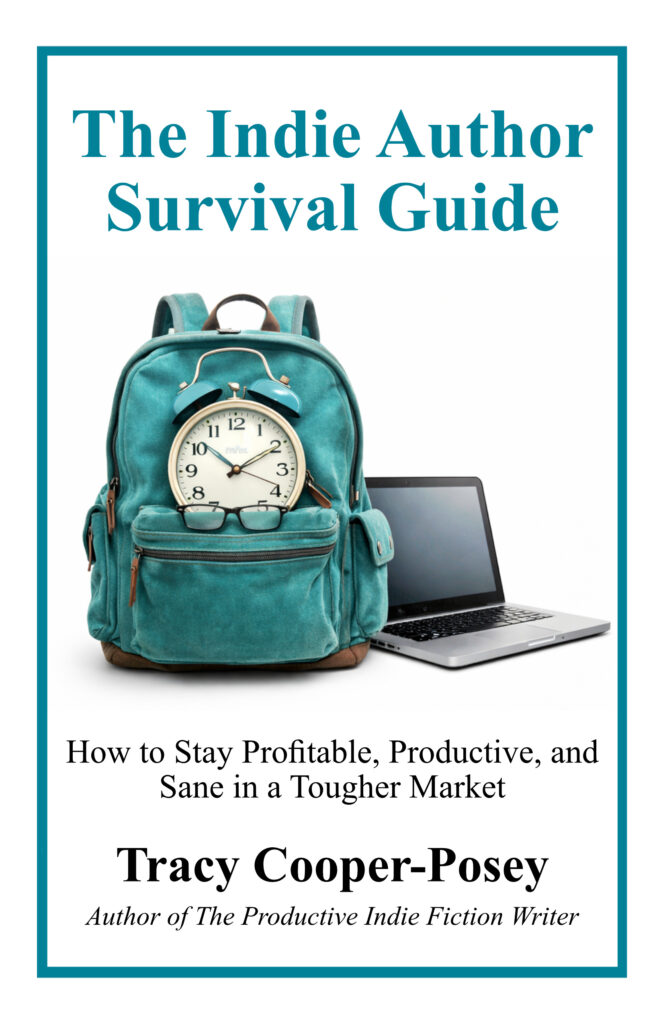
The Indie Author Survival Guide
How to Stay Profitable, Productive and Sane in a Tougher Market
Now Available.

The Productive Indie Fiction Writer: Strategies for Writing More, Earning More, and Living Well
Write More, Faster Than Ever Before | Are You Prolific?
Editing Your Next Novel? Mark Posey offers fast, writer-friendly edits with zero drama. Check out services »