This post is part of the Solar Sail Theory series.
- The Solar Sail Theory of Indie Publishing
- Email List Size Really Does Matter
- Should You Blog? A Solar Sail Theory Answer
- Being Seen: Why Visibility Matters More Than Virality
- Direct Sales and Removing Drag
- Why Fast(er) Writers Build Bigger Sails
- The Death of the Rocket Launch Career
- People Are Part of Your Sail
- Cultivating Luck
- The Magic of Increments
- How to Expand Your Discoverable Surface Area
One of the reasons so many indie authors freeze when they hear the word “marketing” is because they immediately imagine the modern internet version of it; posting constantly on social media, chasing algorithms, building massive followings. Trying to become an influencer instead of a writer.
No wonder people recoil from it.
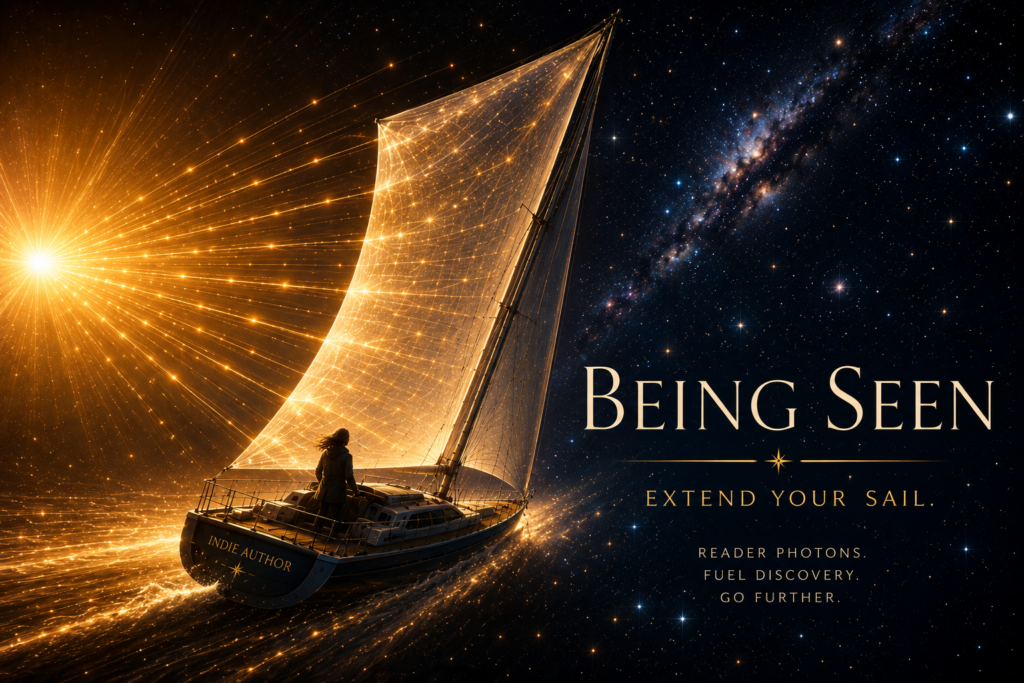
But the “Being Seen” part of Solar Sail Theory is much simpler, and much more sustainable.
You are not trying to become famous. You are trying to become findable.
That’s it.
You are extending the sail. You are increasing the number of ways readers, collaborators, podcasters, bloggers, convention organizers, reviewers, and fellow writers can encounter you over time. Not just this week. Not just during a launch. But months and years from now.
That changes the entire emotional tone of marketing. Now the question stops being: “How do I become visible everywhere?” and becomes: “Does this extend the sail?”
That single question cuts through an astonishing amount of marketing panic.
Compounding Visibility vs. Evaporating Visibility
One of the most useful distinctions indie authors can make is between visibility that compounds and visibility that evaporates.
Some forms of visibility continue working long after you stop actively promoting them. Others disappear almost instantly.
Compounding Visibility
Compounding visibility leaves behind searchable trails. Examples include:
Guest podcast appearances
Show notes, headings, are all searchable, and show up everywhere the podcast is posted; Spotify, YouTube, Apple, the podcast’s website, and more.
Guest blog posts
Bio box at the bottom with a link to your site. Page is indexed by Google, and found by AI Search bots.
Interviews
Videos are stored on YouTube and on the host’s site. Written interviews are even more AI search friendly, and live forever on the interview site, with links back to it from your site, your portfolio and media kit, etc.
If the interview is in a publication (magazine, for example), then the publication itself extends your sail. Digital versions survive forever.
Evergreen blog content
Your own blog posts remain forever, and the evergreen content will be referred back to endlessly by Google, by search bots and AIs, sending readers to your site.
Guest posts on other sites have a bio link back to your site and are rarely removed.
Anthology appearances
Just as your books extend your sail, so does appearing in anthologies; the publisher will have a link to your site—or you can ask for one—and the anthology itself shows up on every retail site.
If the other authors in the anthology are doing their bit to promote the book, then your name and a link to your site (hopefully) shows up on the sites of all the authors in the anthology, too.
Reviews
Reader reviews on retail sites give you pull quotes for your covers and marketing material, but professional reviews extend your sail in a way that reader reviews just can’t replicate.
Pro reviews appear on the review site, in the publication (if they have one – e.g. Locus), and are referred to by genre sites, which provides back links.
Searchable forum discussions
The old internet discussion boards may have faded, but searchable discussion spaces still matter enormously. Modern equivalents like Quora, Reddit, Substack comments, Goodreads groups, StoryGraph community features, YouTube comments, and some genre-specific communities. Even social media that archives and makes discussions both searchable and reachable, will extend your sail.
Months or years later, readers can still stumble across you. And if those appearances point back to your ecosystem; your website, your store, your email list, your reader magnet; then they continue feeding energy into your sail long after the original effort ended.
That is a very different kind of visibility than a social media post that vanishes into the algorithmic swamp by Thursday afternoon.
Evaporating Visibility
Most social media visibility evaporates. That doesn’t mean social media is useless. It means its role is different. Social media is good for reminders, connection, relationship maintenance, and amplifying longer-lasting content. It’s also great for short term promotions (and we’ll get to short term promotions in a minute).
But most posts themselves have very short lifespans. Very few readers are going to discover a tweet from last October and follow it back to your books. Which means social media is usually not the sail itself.
At best, it’s a gust of wind. Useful. Temporary. Gone quickly.
This distinction between compounding and evaporating visibility also changes how you evaluate opportunities. For example: convention panels.
Most in-person panels are not naturally compounding. They are experiential visibility. Human visibility. Relationship visibility. But unless they leave behind searchable artifacts, they evaporate quickly.
An online panel with a recorded replay may continue extending your sail for years. A local panel with twenty attendees and no digital footprint may still be valuable; but for different reasons; it gives you direct human connection, networking opportunities, helps build your reputation, and helps build relationships.
Not all visibility compounds equally. Understanding that helps indie authors stop treating every appearance as equally important.
Visibility Without Discoverability Leaks Energy
A surprising number of indie authors accidentally sabotage their own visibility. Someone hears them on a podcast, sees them on a panel or finds a guest article they wrote. Then they Google the author and discover:
- an outdated website,
- missing books,
- no clear reading order,
- no email signup,
- no biography,
- broken links,
- or a site that appears abandoned.
The sail caught the photon, then let it go. The energy was lost.
Your platform matters.
At minimum, your site should make it easy for readers to:
- understand who you are,
- know what you write,
- find where to start,
- and join your ecosystem.
I am regularly surprised by how many authors do not list all their books, don’t maintain an author bio, or make it difficult to join their newsletter. If readers have to work to figure out how to follow you, many simply won’t.
Visibility without a proper discoverability infrastructure leaks energy.
You Cannot Build Visibility While Hiding
This is the part that makes introverts cringe.
If you only lurk in communities, forums, Discords, Facebook groups, or online spaces, people do not know you are there. You remain invisible, even if you are faithfully hanging out there every day.
But that does not mean you must become loud, fake, hyper-social, or smarmy. It simply means participating.
Participation can be surprisingly low pressure. You can:
- answer questions,
- share useful resources,
- congratulate launches,
- post thoughtful observations,
- volunteer for panels,
- help moderate communities,
- write conference recap posts,
- ask sincere questions,
- or simply become a recognizable, useful presence over time.
Presence matters. Not performance.
Silent Listeners Are Everywhere
One of the strangest realities of online life is this: You do not know who is quietly paying attention.
Readers lurk.
Industry people lurk.
Promo coordinators lurk.
Conference organizers lurk.
Other authors lurk.
Most never announce themselves.
I’ve had moments where this became startlingly real.
A fellow author once reached out after reading a casual comment I’d made online about science fiction romance trends. Another author hosting a BookFunnel promotion emailed me directly after I jokingly referenced the promotion in my newsletter.
Both moments were oddly sobering, because they revealed something important: people are listening even when you think you’re talking into the void.
And the reverse is also true. If you never participate, no one knows you exist.
Most opportunities arrive sideways. Not through formal networking, or through trying to “build a brand,” but through repeated small moments of visibility and recognition over time.
Your reputation becomes part of your visibility. Being thoughtful, useful, generous, and professional matters.
Live Events Still Matter
Markets, conventions, conferences, and live appearances still matter enormously because they create direct human connection. One genuine conversation at a market table can create a stronger emotional connection than dozens of social posts.
People remember humans.
But again, the interaction must connect back to your platform. Provide a business card, or a QR code, a postcard with a free reader magnet, a newsletter signup sheet, or some way that draws the people you speak to at live events back to your platform, later.
The goal is not merely to make a single sale. The goal is to extend the relationship.
Writer Conferences vs. Reader Spaces
Writer conferences are valuable for finding fellow travelers, building professional relationships, forming collaborations, and expanding your peer network. But indie authors sometimes overlook reader-facing spaces.
Reader conferences, fandom spaces, online communities, livestreams, and genre-oriented groups may extend the sail more effectively than purely industry-facing events.
Meaningful relationships can absolutely be built online, so if travelling is an issue, that doesn’t mean you’re doomed as an indie author. Conferences, though, accelerate the process.
Being Seen Is Long-Term Marketing
Being Seen does not replace short-term book marketing. You still need:
- retailer promotions,
- price promotions,
- release campaigns,
- newsletter swaps,
- and all the usual mechanisms that actively push a book in front of readers.
Books still require direct promotion. But “Being Seen” operates on a different timescale. Short-term marketing promotes books. Long-term visibility promotes you.
Over time, those two systems begin reinforcing each other. The larger your sail becomes:
- the more effective launches become,
- the more readers recognize your name,
- the more likely promotions are to convert,
- and the faster your ecosystem grows.
A tiny sail means every launch starts almost from zero. A large sail means your books arrive in front of readers who already know you exist.
The long game strengthens the short game. Not the other way around.
- You do not need to become an influencer.
- You do not need to dominate social media.
- You do not need to become famous.
You need to become:
- visible,
- recognizable,
- searchable,
- findable,
- and human.
You are not trying to shout louder than everyone else. You are simply extending the sail.
Now Available.

The Anti-Ensh*ttification Field Manual for Indie Authors:
Because the platforms will decay…but your career doesn’t have to go down with them.
Now Available.
The Indie Author Survival Guide
How to Stay Profitable, Productive and Sane in a Tougher Market
Now Available.

The Productive Indie Fiction Writer: Strategies for Writing More, Earning More, and Living Well
Write More, Faster Than Ever Before | Are You Prolific?
Editing Your Next Novel? Mark Posey offers fast, writer-friendly edits with zero drama. Check out services »
This is a wonderful post; thank you!!
What do you do when you worry about the kind of visibility you will get – being canceled, or negative reviews? Or accidentally causing drama when you participate, rather than lurk?
Personally, I don’t worry about being cancelled, etc. If I’m being polite and participating as a good net citizen, I should avoid most of those negative situations.
Letting fear of disapproval stop you from being seen means you’re letting other peoples’ opinion shape your actions, and that’s not a healthy place to operate from, as you can’t control what they’re thinking.
Yes, you might get the odd shot across the bows, but the world is full of unreasonable people. Let it go and move on. Enjoy the company and energy of writers who *are* reasonable, and let their company inspire you.
Tracy
Thank you! Maybe time to do that 🙂