This post is part of the Solar Sail Theory series.
- The Solar Sail Theory of Indie Publishing
- Email List Size Really Does Matter
- Should You Blog? A Solar Sail Theory Answer
- Being Seen: Why Visibility Matters More Than Virality
- Direct Sales and Removing Drag
- Why Fast(er) Writers Build Bigger Sails
- The Death of the Rocket Launch Career
- People Are Part of Your Sail
- Cultivating Luck
- The Magic of Increments
- How to Expand Your Discoverable Surface Area
Everyone says that email list size doesn’t matter anymore. Engagement matters. Open rates matter. Clicks matter. You should regularly scrub inactive subscribers. Remove anyone who hasn’t opened in 90 days. Protect your sender reputation at all costs.
I followed that advice once. It was one of the most expensive marketing mistakes I’ve ever made.
A few years ago, I had an email list with more than 25,000 subscribers on it. It had taken me years to build that list, through reader magnets, BookFunnel promotions, back-of-book links, giveaways, and steady accumulation over time.
The problem was that the list looked terrible on paper. Open rates were awful. Single digits. Click rates were microscopic. Every email marketing guru on the internet would have taken one look at those numbers and started reaching for the flamethrower.
Then we ran a Black Friday/Cyber Monday sale. The only marketing we did for that sale was send emails to that list. That was it. No ads. No social media push. No complicated funnel. Just emails.
It was the most successful sale we’d ever had at that point. The revenue from that one promotion sustained our business for a couple of months. That should have been the lesson.
I learned the wrong lesson.
I looked at those tiny engagement numbers and thought: If this disengaged list performed this well, imagine what an active, engaged list could do! Dollar signs blinded me.
So we launched an aggressive re-engagement campaign. It lasted nearly three weeks. We begged readers to click a link to confirm they still wanted to hear from us.
And then we deleted everyone who didn’t respond.
The list dropped from more than 25,000 subscribers to under 2,000.
Watching years of accumulated readers vanish from the dashboard was terrifying. But I told myself this was what smart marketers did. Better engagement. Better list health. Better deliverability.
Then the next Black Friday/Cyber Monday campaign rolled around. We sent the emails. And we got five sales. Five.
Technically, the list was healthier. Open rates improved. Engagement improved. The business results were catastrophic.
That was when I started paying attention to how fiction readers actually behave, instead of how marketing gurus insist customers behave.
Fiction readers are different.
Most email marketing advice comes from entrepreneurs selling software, courses, consulting, productivity systems and ecommerce products. Those businesses depend upon constant interaction and repeated engagement. Fiction readers don’t work like that.
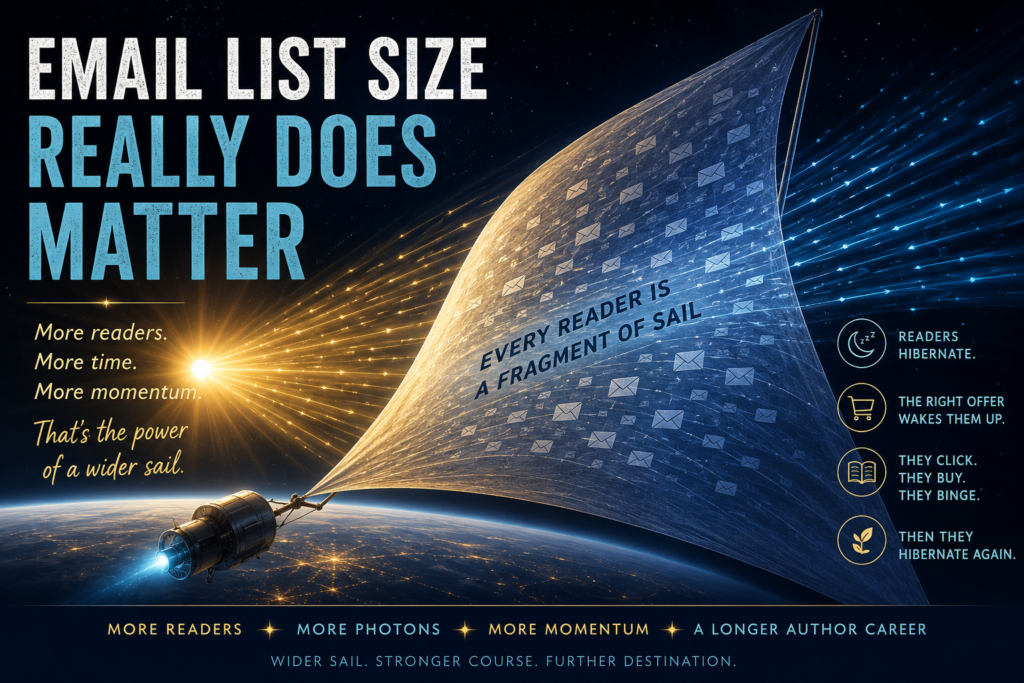
Readers hibernate.
Even your most devoted fans can disappear for months or years at a time. They stop opening emails. They stop clicking. They stop engaging. But they don’t unsubscribe.
Why? Because they’re waiting. They’re waiting for:
- the next book in their favorite series
- a completed series they can binge
- a trope they currently crave
- a sale too good to ignore
- vacation time
- recovery from burnout
- life to calm down enough that reading fits again.
A fiction reader can ignore you for three years and then suddenly buy a twelve-book bundle because you finally finished the series.
That reader was never “dead weight.” They were dormant.
Fiction authors confuse dormant readers with useless readers at their peril. The regular emails you send keep you present in the background of your readers’ minds, even when they’re not actively engaging. Then one day, something you offer lines up perfectly with what they want right now. And suddenly they wake up.
They click. They buy. They binge. Then they go back into hibernation again.
This is one of the reasons I started thinking about what I now call Solar Sail Theory.
A solar sail works because millions of tiny particles of light keep pushing against the sail over enormous stretches of time. The force from any individual photon is microscopic. But the cumulative effect creates momentum. (See my first post in this series for a detailed explanation.)
A long author career works much the same way. Every subscriber who stays on your list is another fragment of sail. Some readers contribute frequently. Some only occasionally. Some disappear for years and then suddenly buy everything you’ve published in a single weekend.
But they all contribute momentum over time. And the wider your sail becomes, the more kinds of readers you can catch.
This is especially important for authors who write in multiple genres, or eventually want to shift genres entirely. A broad readership gives you flexibility. Some readers come for romance. Some for fantasy. Some for science fiction. Some for vampires. Some for Kickstarter collector editions. Some only show up for bundles.
The wider the sail, the more varied the photons you can catch.
Readers hibernate.
Other benefits of a large email list
Large Lists Create Statistical Stability
A larger list smooths out volatility. If you only have 2,000 subscribers, then one bad subject line really hurts. Disappearing inside Gmail’s social tab, or spam tab hurts. A weak launch really hurts. A bad month emotionally devastates you.
But when you have 25,000+ subscribers, you can survive randomness.
Some readers are asleep. Some are busy. Some are grieving. Some are broke. Readers drift off to different or new (sub)genres for a while. Or they’re burned out on reading altogether right now. Some are waiting for a series to finish.
Across a huge list, though, enough people are always waking up at different times to create baseline movement. That matters enormously psychologically and financially.
A larger list changes your own behavior.
This is much harder to graph in a dashboard. But it’s very real. Authors with tiny lists often become desperate and transactional because every open matters too much.
Larger lists encourage abundance thinking. That changes pricing confidence, and launch confidence. Your tolerance for creative risk increases. You also become more willing to build long-term systems to enhance your fiction business. Which, ironically, often improves marketing quality.
A Large List Expands Offer Diversity
This is huge for multi-genre authors especially. (Yes, I’m a good example!) A small “highly engaged” list often becomes homogenized. You unconsciously train the audience toward one genre, tone or type of offer. They become entrenched in one buying pattern.
A small, tightly “optimized” list often starts shaping the author’s behavior in ways that narrow both the audience and the kinds of offers that work. The author begins subconsciously catering to the tiny slice of readers who are visibly active all the time.
So if only your romance readers open regularly, or only bargain hunters click, or only Kickstarter superfans reply, or only one trope cluster engages, then those are the people the metrics keep rewarding. Which means the author starts making decisions based on visible engagement instead of total reader potential.
You end up reinforcing one buying pattern, when in reality, you may simply have deleted or discouraged all the quieter readers who would have responded to different offers.
A larger list contains more hidden variability. You might offer, say, an epic space opera one week, and a deal on a SF planetary romance boxed set the next, and both offers will receive responses from the portions of your list who are interested in those specific offers.
You’re getting averaged out, reliable data from a decent sample. And you’ll keep offering both kinds of fiction, instead of being misled into thinking no one wants your solar punk fiction.
Dormant Readers Still Provide Social Proof Signals
This gets overlooked constantly. Even inactive subscribers:
Inflate Launch Numbers
Even dormant readers occasionally wake up simultaneously. With a small, hyper-cleaned list, your ceiling is lower, your spikes are smaller, and your launches become more predictable but less explosive. With a large list, you can get surprising surges.
For example:
- only 3% of a 25,000 list buy = 750 buyers
- 20% of a 2,000 list buy = 400 buyers
The “healthier” list can still produce a dramatically weaker launch. Launches matter disproportionately because:
- retailer algorithms notice velocity
- direct stores notice velocity
- Kickstarter notices velocity
- ranking systems notice velocity
- “also bought” systems notice clustering
A large dormant list can create sudden synchronized motion when the right offer appears. Especially:
- completed series
- huge discounts
- collector editions
- beloved-character returns
- “last chance” offers
- emotionally resonant launches
Improve Click Pools
This one is statistical. A large list gives more opportunities for accidental virality, unpredictable clicks, segment overlap and dormant-reader reactivation.
Say you have 25,000 subscribers and only 5% click occasionally. That’s still 1,250 possible clickers.
Now compare 2,000 subscribers with a 20% click rate. That’s only 400 clickers.
Bigger pools produce more traffic bursts, more store activity, more pixel firing, more downstream recommendation data and more chances for secondary behavior, because not all clicks are equal.
One click may lead to browsing, wishlisting, buying later, opening multiple pages, reading samples, and talking to friends
You rarely know which click becomes important.
Improve Forwarding Potential
Quiet readers still recommend books. This is massively under-discussed in author marketing. A dormant subscriber may never click publicly, reply or comment, but they still forward your email to everyone they know who they think will like your fiction.
Readers are natural recommenders. Especially fiction readers. And recommendation behavior is often invisible to the author.
A larger list increases the raw number of people who might forward, and in turn, the number of social circles touched. That increases the odds of reaching niche micro-communities.
Even if forwarding rates are tiny, scale matters. 0.1% of 25,000 is still 25 active recommenders. And recommenders are disproportionately valuable.
Create Reply Opportunities
Large lists increase the odds of meaningful replies. Not just more replies, but different kinds of replies. For example: librarians, bloggers, podcasters, convention organizers, binge readers, whales, superfans, reviewers, or potential collaborators. These people often lurk silently for ages before surfacing.
[True story: In a recent email, I commented upon a post I had seen on another author’s site. The author is far more successful than me, and I love her work. I was stunned when she hit reply to my email and thanked me for the plug. I had no idea she was on my email list.]
A tiny list may statistically never contain enough variance in subscribers to generate this sort of serendipity.
A large list, though, increases the connection surface area (i.e. your solar sail) and this in turn increases career opportunities, relationship opportunities, and more.
Sometimes Trigger Recommendation Systems Indirectly
This part is fuzzier because platforms are opaque, but the general principle absolutely exists. Large email list pushes create traffic spikes, coordinated browsing, clustered buying, review activity, wishlist activity, KU page reads (if you’re in KU), sample downloads, “also bought” overlap, and search activity.
Retailers notice patterns. Even indirect activity matters. For example, a dormant reader might click your email, look at the book, but not buy immediately. Later, they’ll search for the book on their preferred retailer, read samples and browse adjacent books. They might do the same thing on your direct sales store, if you have one.
This behavior still feeds systems. Large lists increase the odds of simultaneous behavior, and correlated behavior that increases discoverability ripples.
Large dormant lists are capable of generating concentrated attention when awakened.
The deeper pattern underneath all of this is:
Small optimized systems are efficient. Large messy systems are powerful.
Modern marketing culture worships efficiency metrics because they’re easy to measure. But long creative careers often depend more on resilience, reach, latent capacity, accumulated goodwill, optionality and unexpected reactivation.
Small optimized systems are efficient. Large messy systems are powerful.
Readers Age Into Different Buying Behaviors
This one is massively overlooked in author marketing. A reader who ignores you at 32 may become a superfan at 45. Life stages matter:
- career changes
- retirement
- illness
- divorce
- kids growing up
- commuting habits
- disposable income
- caregiving exhaustion
Fiction consumption changes with life rhythms. Entrepreneur advice treats disengagement as rejection, but fiction readers often disengage because life temporarily crowded out leisure reading. That’s not the same thing.
You are not selling “optimization tools.” You are selling emotional experiences people return to when they have bandwidth. It’s a very different psychology.
The Archive Effect
This one connects directly to a direct-sales strategy. A large list increases the chances readers discover backlist, bundles, alternate pen names, premium editions, Kickstarter launches, collector products, nonfiction, blog posts and everything else in your ecosystem.
The sale that finally wakes them up may not be the thing that monetizes them most. It may simply reactivate the relationship. Then they start exploring.
This is where indie authors radically underestimate LCV. A dormant fiction subscriber is not a failed conversion. They’re an unrealized future read-through.
A dormant fiction subscriber is not a failed conversion.
They’re an unrealized future read-through.
Large Lists Resist Platform Fragility
Every email address is implied permission, direct routing, independent reach and non-algorithmic contact. A large list is an anti-fragility and anti-enshittification infrastructure.
Even dormant subscribers strengthen your independence from retail visibility, social media reach, ad platform unreliability and retailer policy shifts, because they remain recoverable contact points. That’s enormous.
Hibernating Readers Match Fiction Consumption Reality
Readers do not consume fiction continuously. They binge, then hibernate. They return, obsess, and disappear again, only to re-emerge when you launch your next series, or finish one, or for one of the many reasons readers will start reading a favourite author again.
That’s normal reader behavior.
A lot of marketing advice accidentally treats fiction readers like SaaS customers, assuming they are always active, optimizing, clicking and “engaging.” But fiction is emotional and situational.
A reader may adore your work and still not open a single email for eighteen months. Then they go on vacation, or get sick, or burn out at work. They’ll rediscover reading and suddenly need comfort reads. Or they’ll adopt a new trope they suddenly crave, and one of your older series delivers on that trope.
And boom. They buy nine books.
That isn’t bad list quality. That’s how story consumption works.
Don’t confuse temporary silence with permanent disinterest.
Practice Good Email Habits.
Now, to be clear, I’m not saying ignore good email practices. Of course you should remove hard bounces, avoid spammy behavior, write better subject lines, make your offers compelling and respect your readers’ inboxes.
You should always work to grow the list continuously. But you can stop obsessing over open rates. Instead, focus on irresistible offers and improving your subject lines.
Most especially, focus on building long-term reader trust by respecting their inboxes.
But I no longer believe fiction authors should aggressively scrub silent subscribers simply because they’re not opening emails consistently. If their email address still works, and they haven’t unsubscribed, then they are still granting you permission to reach them.
Don’t confuse temporary silence with permanent disinterest. Fiction readers are not productivity customers. They are not SaaS users. They are not optimization machines. They are people who return to stories when they need them.
And often, they come back all at once.
Now Available.

The Anti-Ensh*ttification Field Manual for Indie Authors:
Because the platforms will decay…but your career doesn’t have to go down with them.
Now Available.
The Indie Author Survival Guide
How to Stay Profitable, Productive and Sane in a Tougher Market
Now Available.

The Productive Indie Fiction Writer: Strategies for Writing More, Earning More, and Living Well
Write More, Faster Than Ever Before | Are You Prolific?
Editing Your Next Novel? Mark Posey offers fast, writer-friendly edits with zero drama. Check out services »
Thank you for including the grieving reader.
My wife and partner of 28 years passed away only a couple of weeks ago. I’m still a mass of churning emotions and wounds reminiscent of the victim of a high speed collision with a huge plate glass window. I haven’t wanted to read my email, much less a book. My brain simply wouldn’t process it. Even audiobooks tended to turn into incomprehensible droning much of the time.
I’m also not yet in a position where my previous pattern of simply buying things when they looked good, not just when I had reached that book in the series, has gone on a long pause. I don’t yet know what I’m going to have to live on, and for how long before I have to do drastic things, like sell the house. I do have my Social Security disability, but that’s not enough to do more than barely survive, if enough for that without augmentation. So I’ve gone from feeding the digital Tsundoku to once again being a digital miser. I don’t want to be there again, but, there it is.
Another category to consider is sort of a parasocial group — those who are grieving your series.
We become extremely attached to characters. Especially if a series is a long one, a powerful one, one we’ve invested a lot of time, energy, and resources into following. Have we been to conventions? Do we know the authors? Some of us get so wound up in a series, when it comes to an end, WE GRIEVE. It’s not exactly the same as grieving a real person, but it is very similar. I see it in myself. When the end to a particularly good series hoves into view in the distance, I find myself getting avoidant of the last book or two. I don’t want to know. I don’t want it to end. To my hindbrain, those characters, those people, the vivid beings your words have painted in my mind…are dying. Even if they live “happily ever after”, I won’t know about it. My time with them is at an end. That’s how it can feel, so that’s yet another powerful, if perhaps small in number, group to consider.
I’ve known people who, when a series comes to an end, feel so BETRAYED, they simply stop reading that author. At least for a while. They can’t bring themselves to do so. Thankfully, I’m not THAT bad.
We get to love particular stories. We begin to love the characters. So we want to stick around, and when we can’t anymore, it’s a wrench that’s practically visceral. And sorry, but it can affect your bottom line. Keep an eye out for it starting, and toss those people a bone if you can.
I’m so sorry for your loss, Gwen.
And yes, there are a great many reasons why readers drift away from reading in their lifetime. I certainly do know the wrench of finishing a series (both reading and writing one). It’s nowhere even close to the same as losing a spouse, but it does leave a small hole in your life.
Thank you for your thoughts.
Tracy