This post is part of the Solar Sail Theory series.
- The Solar Sail Theory of Indie Publishing
- Email List Size Really Does Matter
- Should You Blog? A Solar Sail Theory Answer
- Being Seen: Why Visibility Matters More Than Virality
- Direct Sales and Removing Drag
- Why Fast(er) Writers Build Bigger Sails
- The Death of the Rocket Launch Career
- People Are Part of Your Sail
- Cultivating Luck
- The Magic of Increments
- How to Expand Your Discoverable Surface Area
One of the most persistent myths in publishing is that writing quickly somehow produces lower-quality work. I’ve tackled that myth before, more than once. If you’re interested in the details, take a look at Let’s Bury Fast = Crap and Does Writing Fast = Crap? The short version is that speed and quality are not opposites. They’re separate variables.
Solar Sail Theory offers a completely different reason to think about writing speed. Not because faster writers make more money, or release more often, or because their speed lets them game algorithms (an increasingly less significant edge, now that AI is flooding the markets and the markets are adjusting the algorithms in response).
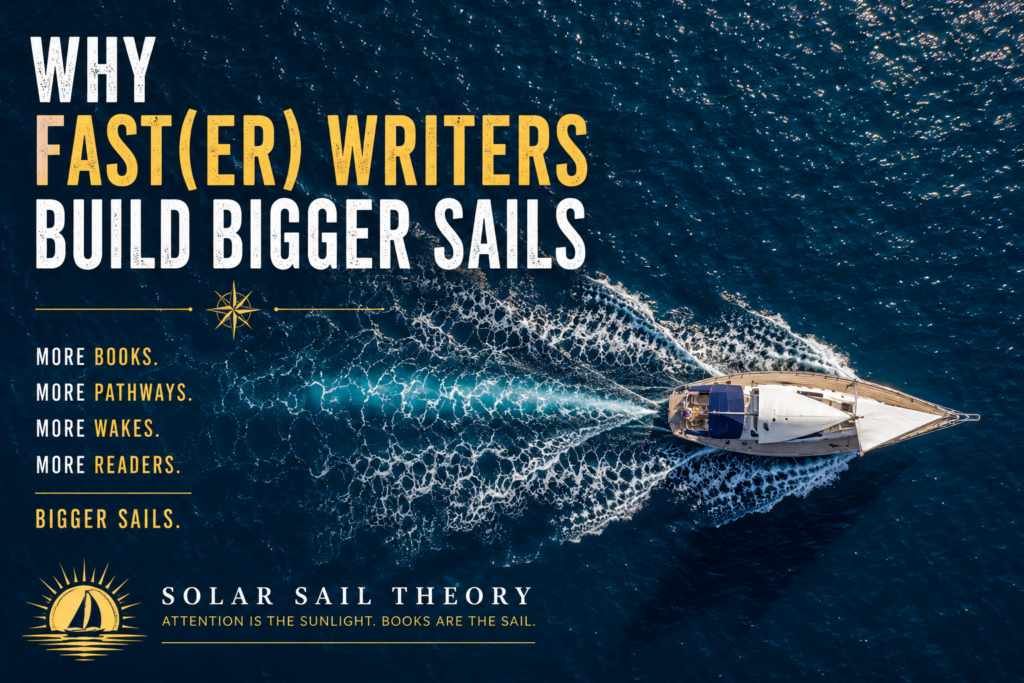
Instead, Solar Sail Theory says that faster writers build bigger sails.
Every Book Is Sail Area
In Solar Sail Theory, discoverability is not something you manufacture through clever marketing. It’s something you accumulate. Every book you publish becomes another way for readers to find you. Each book creates:
- A product page on your store.
- A product page on retailers.
- A series page.
- Metadata.
- Search results.
- Reader recommendations.
- Reviews.
- Links.
Most importantly, it creates another doorway into your work. Readers rarely discover authors the way authors imagine they will. A reader may find your newest release, or your oldest book (I’ve had readers who’ve found my oldest books in paperback in a secondhand store…then screamed in delight and bought everything else I had since published).
Readers will often trip over the second or third or later books in your series. I’ve done this myself. I’ve seen a cover or title that caught my eye, found out it was book 3 or later, and gone back to find book 1. Book 1 was a book I’ve seen multiple times in the past and it didn’t grab me. But now I buy it because I want to read book 3.
Readers can find you in anthologies, or a short story in a pro magazine, or given away somewhere else.
The point is that every story becomes another panel in your sail. The larger the catalogue, the larger the sail.
Time Matters
A book published today starts working today. A book published next year doesn’t. This seems obvious, yet many authors overlook the implications.
Imagine two authors who eventually publish twenty books. One publishes those books over ten years. The other publishes them over thirty. At the end of thirty years, both authors have the same number of books.
But they do not have the same sail.
The first author’s books have been gathering readers, reviews, recommendations and links for decades longer. Those discoverability effects compound. The books don’t simply exist. They’ve been working.
Every year a book is available is another year it can be found.
A book sitting unpublished on your hard drive isn’t part of your sail. It can’t attract readers, leave a wake, or compound its discoverability. It has to be in the world before it can begin working.
The Wake Behind Every Book
This is the part many authors never consider. When you publish a book, you aren’t only publishing the book. You’re also creating a wake.
Think about a ship crossing the ocean. The ship passes. The wake remains behind it. Books do the same thing. A release generates activity:
- Podcast interviews.
- Guest posts.
- Blog tours.
- Articles.
- Reviews.
- Social media discussions.
- Newsletter mentions.
- Convention appearances.
- Awards entries.
Most of these seem temporary at the time. You do the interview. It runs. You move on. You write the guest post. It publishes. You forget about it. But many of these things remain online for years. Sometimes decades.
I’ve had people contact me because they found an old interview, or a guest article, or a review, or some other piece of content I had completely forgotten existed.
The book created the opportunity. The opportunity created the wake. The wake continued attracting attention long after the original release was over.
One book creates a wake. Many books create many wakes. And if you’re even a little bit familiar with boats, have you noticed that the further behind the boat, the wider the wake? This applies to book wakes, too.
Over time, those wakes spread throughout the internet, creating additional paths that can lead readers back to your work.
More Chances to Get Lucky
One of the most uncomfortable truths in publishing is that nobody knows which book will resonate. Not the author, the publisher, the retailer, nor the marketing expert. I always think of William Goldman’s quote about Hollywood when talking about luck in publishing. He said;
“Nobody knows anything…… Not one person in the entire motion picture field knows for a certainty what’s going to work. Every time out it’s a guess and, if you’re lucky, an educated one.”
He was speaking of Hollywood, but it applies equally to book publishing, which is just another type of story-telling.
Books surprise us all the time. The book you expect to be a breakout success may quietly find a small audience. The book you almost didn’t write may become a reader favourite.
A guest article written in an afternoon may still be attracting visitors years later. An interview you barely remember recording may introduce someone to your work a decade from now (ask me how I know that one).
Solar Sail Theory doesn’t assume that we can predict these outcomes. It assumes the opposite. The future is uncertain. Readers are unpredictable. Discoverability happens in ways that cannot be fully planned.
The answer is not to become better at predicting luck. The answer is to create more opportunities for luck to occur. Every book adds sail area. Every book creates pathways, and leaves a wake.
Every book creates another opportunity for an unexpected gust of sunlight to push a reader in your direction.
Over time, those opportunities accumulate. And while no one can manufacture luck, authors can absolutely increase the number of chances they have to encounter it.
Production Is Discoverability
One of the traditional arguments for writing quickly is that more books create more opportunities to earn income. That’s completely true. But Solar Sail Theory looks at the situation differently.
Every finished book becomes a discoverability asset. Every book increases the number of ways readers can encounter your work. It adds another panel to your sail.
Every book leaves another wake behind it.
The goal isn’t speed for its own sake. The goal is building a body of work that can continue attracting readers long after you’ve finished writing it. Fast writers build bigger sails because they build more discoverability assets.
They also build them sooner.
And once those assets are in the water, they can keep working for years.
Now Available.

The Anti-Ensh*ttification Field Manual for Indie Authors:
Because the platforms will decay…but your career doesn’t have to go down with them.
Now Available.
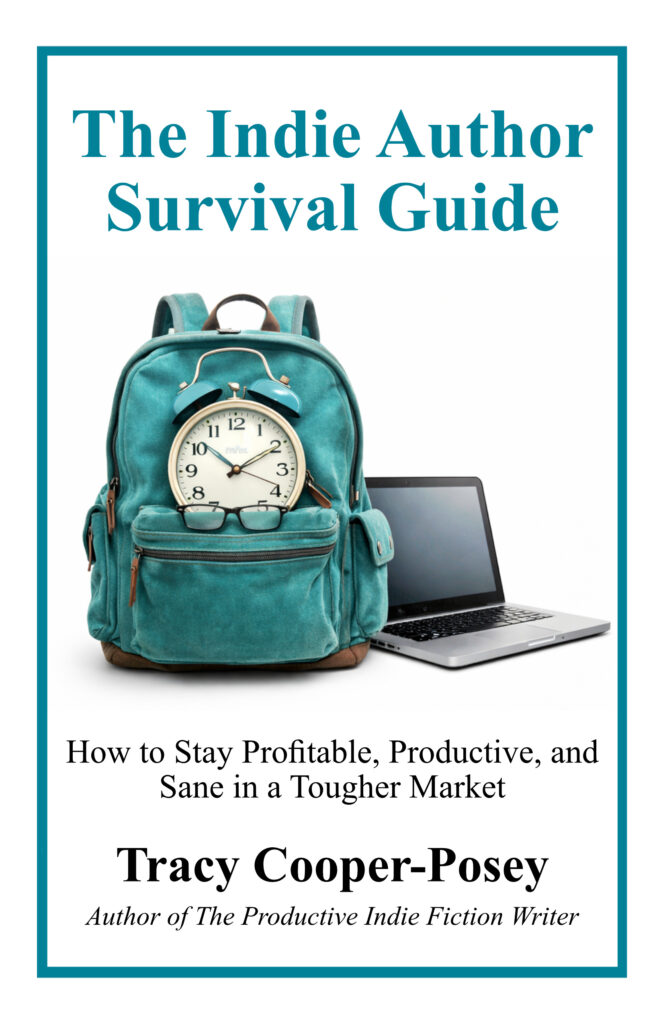
The Indie Author Survival Guide
How to Stay Profitable, Productive and Sane in a Tougher Market
Now Available.

The Productive Indie Fiction Writer: Strategies for Writing More, Earning More, and Living Well
Write More, Faster Than Ever Before | Are You Prolific?
Editing Your Next Novel? Mark Posey offers fast, writer-friendly edits with zero drama. Check out services »