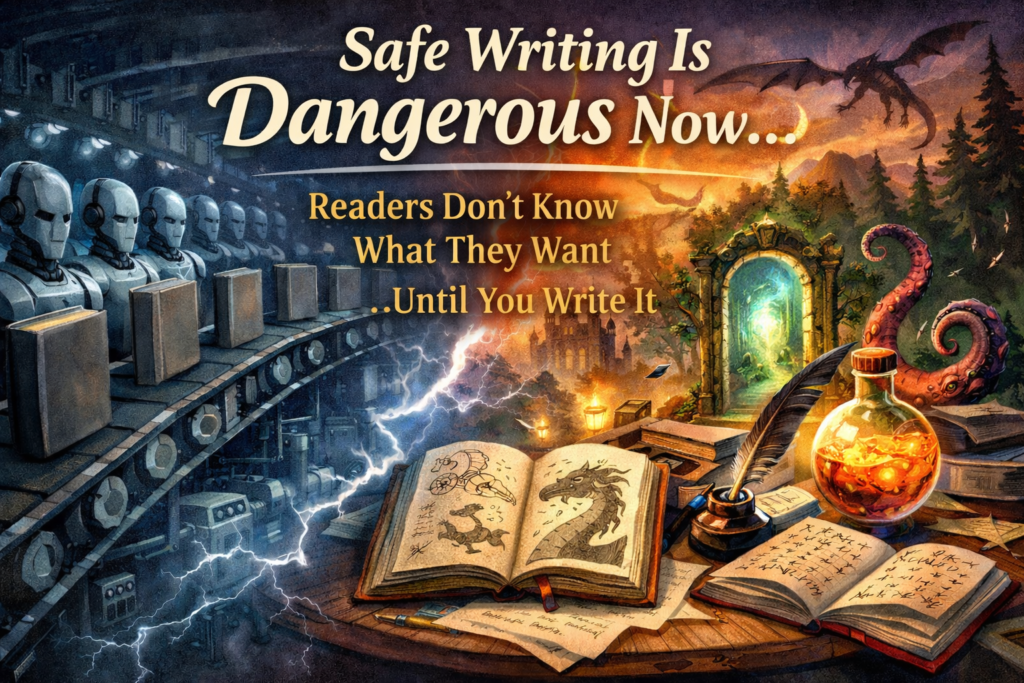
If you’ve been writing for longer than three microseconds, then you’ve undoubtedly heard the advice “write what readers want.” It sounds like good advice, but these days, it’s dangerous.
Yet if you can’t safely compete by writing the familiar, market-approved book anymore, what do you write instead?
There is an important distinction to make here. “Write what readers want” is not quite the same thing as “write to market.”
“Write to market” is the steroid version. It tells you to study the trends, identify the hottest categories, reverse-engineer the covers, tropes, and blurbs, and then produce a book that fits the current demand as efficiently as possible.
I’ve sat through workshops where this process of reverse engineering best-selling books was demonstrated; the workshop coordinators went so far as figuring out on what page of the story the xxx scene took place, and the page count for each scene. It was a romance workshop, so they even plotted on a graph where the first kiss occurred and when the “I love you scene” happened. They built tables of commonly used words, and graphed the average length of sentences.
“Write what readers want” isn’t nearly as engineered. “Write what readers want” might mean making your heroine American because most of your readership is from the US. Or adding a romance sub-plot because your readers seem to respond well to them. Or extended a novella into a novel because readers have told you they prefer them. Or changing a character, relationship, or ending because you think that would please more readers (or piss off less of them).
It means writing another fantasy romance because they sell the best out of all the genres you write.
“Write what readers want” sounds gentler. Kinder. More reasonable. But underneath, it often leads to exactly the same place: It still asks you to look outward first.
It teaches you to distrust your own instincts and to treat your own ideas as suspicious unless they have already been pre-approved by the market.
It nudges you to write the safer version, the more familiar version, the easier-to-explain version.
Writing what readers want is increasingly a useless exercise.
If your entire strategy is to figure out what readers already want and then give it to them, you are competing in exactly the territory where AI and an increasingly crowded market are strongest.
“Write what readers want” sounds sensible. Practical. Market-aware. It is also, increasingly, a trap.
For years, authors could make a reasonable living by writing “the same but different” stories. Find the current trend. Add a slight twist. Deliver the expected beats. Repeat.
- Vampires, but in a small town.
- Space opera, but with found family.
- Romantasy, but with dragons.
You could build an entire career by being close enough to familiar that readers felt safe, but different enough that they felt they were getting something new. And no lie: there are many readers who want those safe, comfortable reads. They’re reading stories for different reasons than readers who crave novelty (where the word “novel” came from), who love the unexpected.
The problem is that we no longer have a monopoly on same-but-different stories.
Generative AI is astonishingly good at producing average. It can remix existing patterns at industrial scale. Give it enough examples and it can generate endless variations of “the thing that sounds like the thing you already liked.”
Commodity fiction is about to become even more commoditized.
If your strategy is to compete on speed, volume, and surface-level familiarity, you are competing with a machine that never sleeps, never gets discouraged, and can produce ten thousand words while you are making tea and wondering where you left your glasses.
That is not a battle you want. Fortunately, you do not have to fight it.
What Readers Really Want
The things AI is worst at are the things that make your work worth reading: The strange combinations. The deeply personal obsessions. The ideas that should not work, but somehow do. The unexpected connection between two things that seem completely unrelated.
Readers can usually tell you what they already want:
- More enemies-to-lovers
- More cozy fantasy
- More morally grey heroes
- More found family in space
But here’s the thing. This is the incredibly important part that most writing advice fails to mention: What readers cannot usually tell you is what they are desperately waiting for:
- Post-apocalyptic sentient forests plus clipped-wing angel trauma recovery
- A portal fantasy crossed with bureaucracy and emergency management
- A writing book that is secretly about building an external brain
- Cozy fantasy crossed with midlife reinvention and grief
Readers are very good at recognizing familiar ingredients. They are much less good at imagining the dish they will love before they have tasted it.
Your job is to present those weird ideas and combinations
Provide readers with the stories they didn’t know they needed. Presenet ideas that make them sit up and go “yes, this is exactly what I want to read!”
Your advantage is not that you can write faster than AI. Your advantage is that you are weirder.
You have lived a specific life. You have a particular set of interests, experiences, grievances, curiosities, and emotional scars. You are the only person who would think to connect those things in exactly the way you do.
Often, the best ideas do not arrive fully formed. They arrive as two unrelated fragments that suddenly collide.
You write down:
- a note about why platforms are becoming less trustworthy
- an idea about notebooks and memory
- frustration with social media and algorithms
- a half-formed thought about how authors need to build systems outside the platforms
Then one day your brain abruptly says:
Oh. This is not a book about notebooks. It is a book about externalizing the creative mind in an age of enshittification.
Or:
This is not just a portal fantasy. It is a story about people whose job is to hold reality together while the institutions around them quietly fail.
That spark is the thing no algorithm can manufacture on purpose, which means the old advice needs an update. Instead of asking: What do readers want?, try asking: What idea keeps returning, even if it doesn’t fit my current brand, genre, or production plan?
The Process of Growing Ideas
Asking this question makes the process a, well, process. Brainstorming and working in your notebooks to revisit and develop ideas, to test them and see if they still have energy is a fantastic way of building up unique stories.
But often, weird ideas arrive at other times, usually when you’re doing something that requires both hands and an insurance policy. Or when you’re showering (weirdly, that is not where I get my good ideas, although many writers do — that’s why aqua-note pads were invented). Or when you’re staring out the window at the snow clouds coming in from the north and wondering whether your roses will bloom this year.
This is why having multiple ways to capture ideas in the moment are useful. That’s all you have to do; get the idea down. You can revisit the idea later, in your notebook.
And here’s the other side of this process: Do not discount the strange ideas.
Those recurring, inconvenient, slightly embarrassing ideas are often the important ones. The ideas that make you think “This is probably too strange,” are very often the ones with the most energy.
Not every weird idea has to become your next major series. Some will become:
- a short story
- a novella
- a side project
- a bonus for your readers
- a blog post
- a failed experiment that later turns into something better.
But if an idea keeps coming back, do not dismiss it because it is out of oeuvre, off-brand, or difficult to market. The market is shifting under our feet. The safest place is no longer in the middle of the herd.
The safest place is where you are unmistakably yourself.
No matter how good AI gets at producing “more of the same,” it still cannot compete with the one thing you have that it never will: Your particular way of seeing the world.
And frankly, that is where the interesting books have always come from.
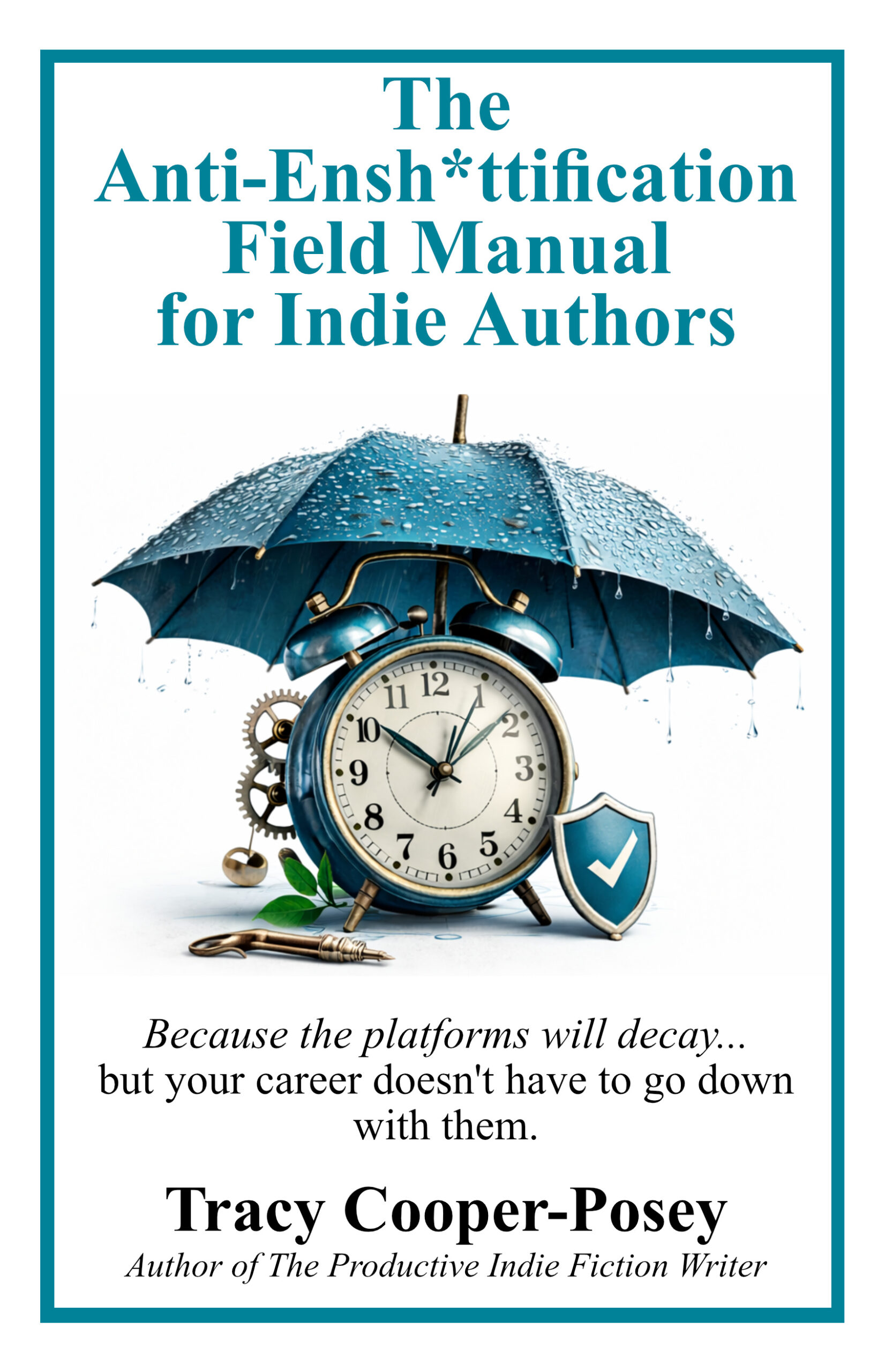 Now on pre-order: The Anti-Ensh*ttification Field Manual for Indie Authors: Because the platforms will decay…but your career doesn’t have to go down with them.
Write More, Faster Than Ever Before | Are You Prolific?
Editing Your Next Novel? Mark Posey offers fast, writer-friendly edits with zero drama. Check out services »