Lately, everywhere I turn, someone is explaining how to spot scammers. There are lists. Red flags. Tip-offs. Helpful little checklists:
- Watch for this phrase
- Be wary of that behaviour
- If they say this, it’s probably fake
And while all of that is useful, it completely misses the real issue, because none of those clues matter if your mindset is wrong.
If you want what they’re offering, you will explain away every red flag. You will rationalize the weird phrasing. You will overlook the strange domain name. You will tell yourself they’re just busy, just informal, just enthusiastic. And that’s exactly what these people are counting on.
Mechanical Harvesting Of Contacts
A few weeks ago I got yet another email. It was flattering. Specific. Referenced a real podcast interview I did. Praised me for “giving value” unlike other guests. Asked if I wanted to be placed on “top-tier shows in my industry.” Mentioned impressive clients.
It was followed up a few days later with another email asking why I hadn’t replied.
On the surface, it looked like opportunity. Underneath, it was a machine.
The email had scraped details from my online presence, fed them into AI, and produced something that felt personal. The follow-up wasn’t human impatience; it was CRM software automatically nudging a “lead.”
That was the moment it really clicked for me.
These people aren’t firing off random emails from a basement. They’re using the same kind of professional-grade customer relationship management software that legitimate businesses use to track prospects and sales pipelines. To them, you are not a person. You are an entry in a database.
The system records that the first email was sent. It waits. If you don’t reply, it automatically sends a follow-up. Then another. Sometimes another after that. Different wording. Different sender name. Different domain. All pre-programmed.
They are systematically, methodically working a list of authors the way a sales team works a list of corporate clients. Once you’re in that system, they don’t forget you. Not because they care, but because the software doesn’t.
This is industrialized persistence. Not a single stone left unturned. Not a single potential “lead” allowed to slip quietly away. You’re not being contacted by a person. You’re being processed by a machine designed to extract a response.
This wasn’t outreach. This was industrialized hope-harvesting. And authors are prime targets. Why?
Authors Are Particularly Vulnerable
Because we want to be discovered. We want recognition. We want someone to notice us and say, “You. You’re worth talking to. You’re worth promoting. You’re worth putting in front of an audience.”
We are tired of pushing uphill. Tired of being the one doing all the initiating. Tired of feeling like we’re shouting into the void. So when something arrives that looks like the opposite of that, when someone appears to have found us, it hits a very soft, very human spot.
That’s the spot the scammers aim at.
I was recently asked by a new writer, fresh manuscript in hand, what to do next. I had a lot to say about pitfalls and traps in indie publishing. But really, most of them can be avoided if you understand one thing:
Publishing takes work. Hard work. Time. Learning. And a bit of money.
It takes time to write a book. Then more time to learn the industry, the tools, the platforms, the business side of things. It takes effort to build systems, relationships, skills.
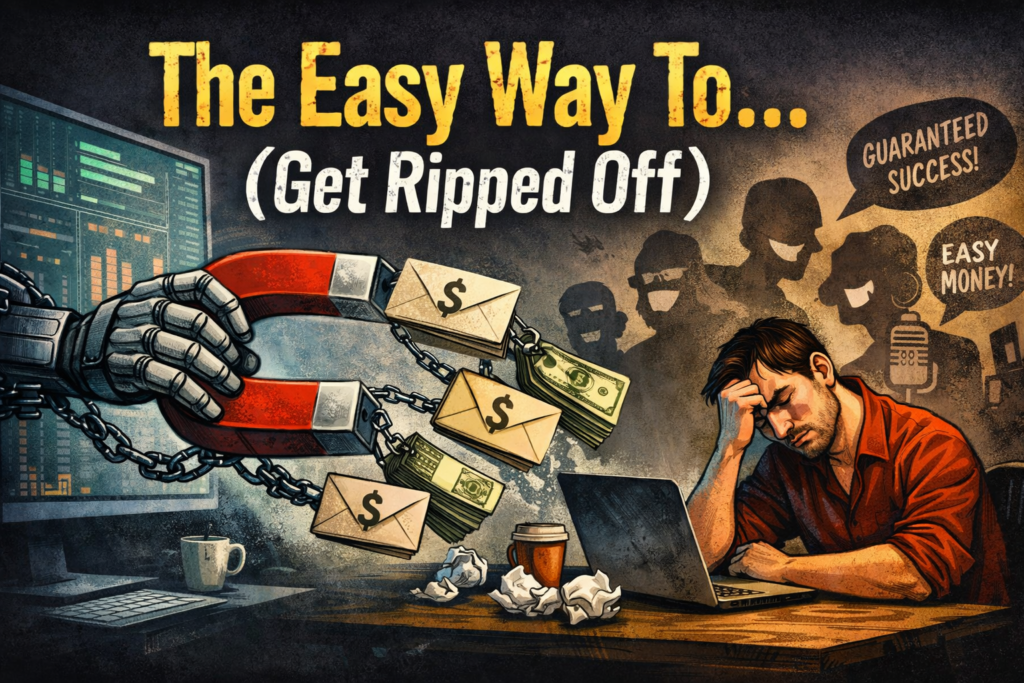
If you truly accept that — emotionally, not just intellectually — you become almost impossible to scam. Because every scam, every con, every shady service is selling the same thing: The easy way.
They’ll publish your book for you. They’ll market it for you. They’ll get you reviews. They’ll boost your Amazon ranking. They’ll book you on podcasts. They’ll write your copy. They’ll “handle everything” so you don’t have to think, research, or learn.
They promise faster. Easier. Overnight. Days instead of years. They are offering relief from the work. And that’s the tell.
This is why all the “how to spot a scam” advice only goes so far. If part of you is still hoping there’s a secret handshake, a password, a hidden door that skips the long, slow, unglamorous work of building a writing career, you are vulnerable.
You will want to believe. But there is no secret handshake. No mystical door. No shortcut. There is only work and time.
The Default Posture You Should Adopt
I’ve reached a new default position in the last year:
If they approached me cold, it’s probably fake.
That’s not cynicism. That’s adaptation. Real opportunities don’t arrive as vague flattery from unknown domains asking if you’d “be interested.” Real opportunities name the show, the person, the context, and why you’re a fit. They don’t feel like a sales funnel. They feel like a conversation.
The difference, once you see it, is obvious. And incredibly freeing.
Here’s the part most authors need to hear:
- You do not owe these people politeness.
- You do not owe them a reply.
- You are not missing out.
You are protecting your time, your focus, and your energy. Mark as spam. Move on. Because the “easy way” is always the expensive way.
The real shortcut, the only one that exists, is accepting that there are no shortcuts at all.
Pre-order now.

The Anti-Ensh*ttification Field Manual for Indie Authors:
Because the platforms will decay…but your career doesn’t have to go down with them.
Pre-order now.

The Indie Author Survival Guide
How to Stay Profitable, Productive and Sane in a Tougher Market
Now Available.

The Productive Indie Fiction Writer: Strategies for Writing More, Earning More, and Living Well
Write More, Faster Than Ever Before | Are You Prolific?
Editing Your Next Novel? Mark Posey offers fast, writer-friendly edits with zero drama. Check out services »